Swimming Headphones: What You Actually Need (and Why Bluetooth Fails Underwater)
Published 2026-10-16 · Updated 2026-10-16
The short answer
Bluetooth does not transmit through water, so a swimming headphone needs onboard storage rather than a phone connection, plus a water rating that covers immersion — IPX7, IPX8, IP68 or IP69, not the IPX5 or IPX6 that covers jets. Bone conduction is a driver technology, not a water rating, so a bone conduction model rated IPX5 will survive sweat and fail in a pool. The KORAVIS range stops at IPX6, so none of its models is swim-rated.
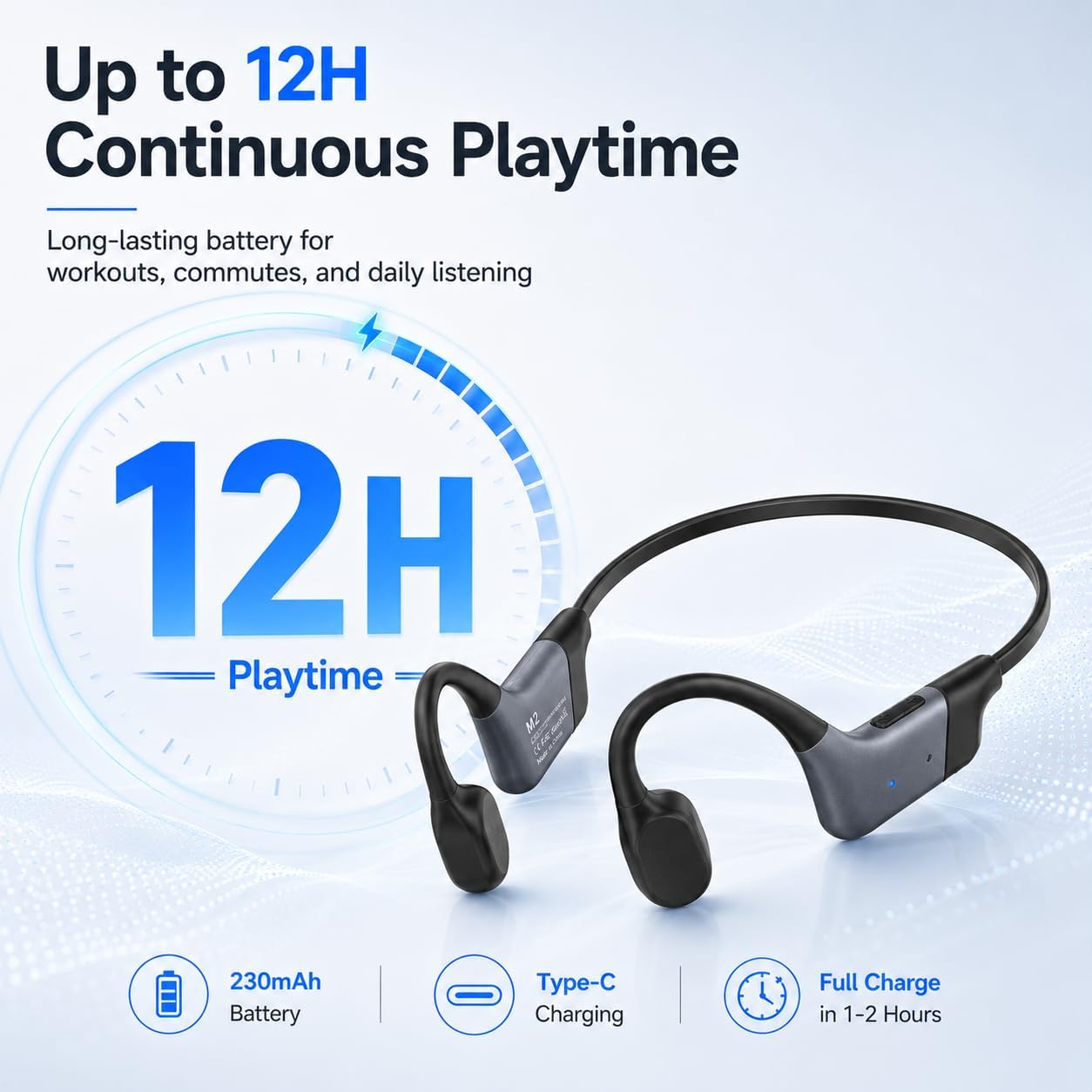
Short answer: Most swimming headphones fail for a reason that has nothing to do with water — Bluetooth does not transmit through water. A headphone can be perfectly sealed and still be useless in a pool, because the signal from your phone stops at the surface. Real swimming headphones therefore need two things, not one: an IPX7 or IPX8 immersion rating, and onboard music storage (typically 8–32 GB) so the audio travels on your head instead of through the air. If you are shopping for waterproof headphones for swimming, check those two specifications before price, weight or brand.
This guide explains the requirement, how to verify it on a spec sheet, and why the KORAVIS range deliberately stops short of it.
The part nearly every buyer misses: Bluetooth stops at the surface
Radio at 2.4 GHz — the band Bluetooth uses — is absorbed strongly by water. That is the same property that makes microwave ovens work. A human body in open air already attenuates the signal enough to cause dropouts; several centimetres of water attenuate it far more completely.
The practical outcome is a failure that looks like a hardware fault but is not: you put the headphone on at the poolside, music plays fine, you push off, and the audio dies within a second. It resumes the moment your head breaks the surface. Nothing is broken. The signal simply did not follow you in.
This is why "swimming headphones bluetooth" is a search phrase that leads people to the wrong products. Bluetooth is the transport method, and it is the one transport method that cannot work underwater.
Two requirements, not one
Almost every product sold as swim-capable is judged on water resistance alone. That is half the specification.
| Requirement | What it must be | Why it is non-negotiable |
|---|---|---|
| Immersion rating | IPX7 (1 m / 30 min) or IPX8 (deeper or longer, per the maker) | IPX5 and IPX6 are jet ratings — they test spray, not submersion |
| Onboard storage | 8–32 GB of built-in memory | Bluetooth cannot cross the water, so the music has to be carried |
| Fit under a cap | Band or ear hook that survives head turns and push-offs | Goggles and caps change the geometry of your head |
| Contact resilience | Plated or covered charging contacts | Pool water is chlorinated; sea water is saline. Both corrode bare metal |
A product that lists IPX8 but no storage is a waterproof headphone, not a swim headphone. Plenty of bone conduction swimming headphones on the market make exactly this mistake in reverse — a transducer built for the water, riding on electronics that cannot reach it. A product with 32 GB of storage but an IPX5 rating will survive sweat and rain and then fail on the first lap. You need both, and the spec sheet has to show both.
Waterproof bone conduction headphones are not automatically swim headphones
This is the most common and most expensive mistake in the category.
Bone conduction and swimming look like a natural pairing — the transducer sits outside the ear canal, so there is no seal to break and no tip to fall out. That part is true, and it is genuinely useful in a pool. But the driver technology has nothing to do with whether the device can survive immersion, and it has nothing to do with whether the audio can reach the transducer.
So when you see waterproof bone conduction headphones swimming-focused marketing on a listing, read the two numbers rather than the headline. Waterproof bone conduction headphones swimming laps still need an immersion rating on the housing and memory inside the unit. Marketing the mechanism does not supply either.
A second point worth knowing: bone conduction is arguably the better mechanism for swimming, because nothing enters the ear canal and nothing depends on a seal that water pressure can defeat. If you are choosing a swim headphone and both options have the required rating and storage, the bone conduction model usually has fewer parts to fail.
If you already own swimming headphones and the audio cuts out mid-lap, the two sections below are the ones that explain why.
How to check a swim headphone in about ninety seconds
Work down this list. The first two are pass/fail.
- Find the IP number. Ignore "waterproof", "swim-ready", "sweat-proof". Look for IPX7 or IPX8. If the highest figure on the sheet is IPX5 or IPX6, stop here — it is a land headphone.
- Find the storage figure. Look for GB. No storage means it depends on Bluetooth, which means it stops at the surface. Some units also do FM radio; that is not a substitute, because the signal still has to reach the device.
- Confirm the fit. A band or an ear hook that survives a push-off and a tumble turn. Loose earbuds are lost in pools.
- Check the charging contacts. Exposed contacts need rinsing and drying after every swim — chlorinated and saline water both attack them.
- Check the earplug decision. Some swim models are designed to be paired with earplugs, which changes what you hear. Decide whether you want open-ear awareness in the water.
Anything that passes all five is genuinely usable for laps. Anything that passes the first two is at least honest about what it is.
Bone conduction headphones for swimming: the form-factor question
There is a real disagreement about which design works best in water, and it is worth thirty seconds because it affects what you buy.
The band-over-the-head design holds the transducer against the cheekbone reliably and survives push-offs without fiddling. It is the more common choice in bone conduction headphones for swimming. The trade-off is that it can conflict with a swim cap and with goggles.
The ear-hook design stays clear of a cap but depends more on tension, and tension changes when your skin is wet. Fit degrades over a session.
Neither is wrong. If you train with a cap on, try the fit before committing — this is the specification most often discovered too late.
Why the KORAVIS range stops at IPX6
We make open-ear headphones for land training, and we are not going to imply otherwise.
- M2 — IPX6, 12 hours, 25.5 g. Rated against strong water jets: sweat, rain, sustained weather.
- M3 — IPX5, 12 hours, bone conduction.
- Q1 — IPX5, 8 hours, air conduction, 18.2 g.
All three sit at around $20 and all three are designed for running, cycling and the gym. None of them is a swimming headphones product, and none is rated for immersion.
The reason is not durability, it is architecture. A swim-capable unit needs a sealed housing designed for immersion and 8–32 GB of internal memory to hold the music, because Bluetooth will not reach it under water. That is a different device with a different bill of materials, and adding it means doing it properly rather than attaching a water rating to an existing frame.
So the honest answer is this: if you swim, buy a dedicated swim headphone. If your training happens on land and you want the strongest water protection in our range for rain and heavy sweat, that is the M2 at IPX6.
An important boundary: waterproof swimming headphones still need care
Immersion ratings are tested in fresh water on a new, undamaged unit. They say nothing about the two things that end swimming headphones early:
- Chlorine and salt. Both are chemically more aggressive than fresh water. Rinse the unit in fresh water after every pool or sea session, then dry it.
- The charging contacts. Rinsing protects the housing; drying protects the contacts. Never charge a wet unit — that is the single fastest way to kill it.
Treat the rating as a ceiling on a new device rather than a promise about an old one. Seals age, and a two-year-old IPX8 unit is not as water-resistant as it was in the first month.
If you only swim occasionally
There is a middle case worth naming. Some people search for waterproof headphones for swimming because they swim a handful of times a year, and they do not want a second pair of headphones for it.
For that case the requirement does not change — you still need immersion protection and onboard storage for the session itself — but you can buy at the low end of the storage range. A smaller-capacity swim unit is cheaper and holds several hours of audio, which is more than a training session.
What you should not do is take a land headphone into a pool because it is labelled waterproof. IPX5 and IPX6 are spray ratings. The pool is the one environment where the gap between "waterproof" and "immersion-rated" is physically real.
FAQ
What are the best swimming headphones?
There is no single answer, because it depends on two specifications rather than on brand: an IPX7 or IPX8 immersion rating, and built-in storage so the audio does not depend on Bluetooth. Filter on those two first, then compare fit, battery and price. Any model that shows both is a genuine candidate.
Do I need special headphones for swimming, or will any pair do?
Yes, and for a reason that is not about water sealing. Bluetooth does not transmit through water, so a normal wireless headphone loses its signal the moment your head goes under — even a fully waterproof one. Swimming headphones carry the music on board instead.
Can I swim with bone conduction headphones?
Only if that specific model is immersion-rated (IPX7 or IPX8) and has onboard storage. Bone conduction is a driver technology, not a water rating, so a bone conduction headphone rated IPX5 will survive sweat and fail in a pool. The mechanism is well suited to swimming; the rating still has to be there.
Are waterproof headphones for swimming the same as waterproof headphones?
No, and the difference is the whole point. Most "waterproof" headphones are rated IPX5 or IPX6, which certifies them against directed water jets. Swimming requires IPX7 or IPX8, which certifies immersion. A jet rating tells you nothing about how the unit behaves underwater.
Why does Bluetooth not work underwater?
Water absorbs 2.4 GHz radio energy efficiently. The signal attenuates within a few centimetres, so it cannot reach a headphone below the surface. This is a property of the medium, not a limitation any manufacturer can engineer around.
How much onboard storage do swimming headphones need?
Enough for a session, which in practice means low single-digit gigabytes. Most swim models ship with 8–32 GB, and that range reflects audio bitrate and file format far more than session length. A smaller capacity is the cheaper, perfectly adequate option if you only need it for laps.
Can I use the swimming headphones bluetooth mode at the pool?
You can, and it will work while your head is above water — poolside, in the locker room, walking to the pool. It will drop as soon as you submerge. Treat Bluetooth on a swim headphone as a convenience for everything except the laps themselves.
Does chlorinated water damage headphones?
It is harder on them than fresh water. Chlorine and salt are both chemically aggressive toward plated metal, which is why the charging contacts are the usual failure point. Rinse in fresh water after every session, dry the contacts completely, and never charge a wet unit.
Sources
- IEC 60529 — Degrees of protection provided by enclosures (IP Code): definitions of IPX5, IPX6, IPX7 and IPX8, and the distinction between jet and immersion testing
- Shokz OpenRun Pro 2 — official product page — an example of a land-focused open-ear model, rated IP55, that the manufacturer explicitly states is not suitable for swimming
- SoundGuys — the best bone conduction headphones — independent testing across bone conduction models, including notes on onboard storage and water ratings
- RTINGS — headphone test methodology — how connectivity and range are measured, and why submerged radio links behave differently
- Soundly — an audiologist's review of bone conduction headphones — clinical notes on the bone conduction pathway and the role of the ear canal remaining open