Best Bone Conduction Headphone Brands Besides Shokz (2026)
Published 2026-10-11 · Updated 2026-10-11
The short answer
If you want a bone conduction headphone that is not a Shokz, three brands are worth your money in 2026: Mojawa for swimming (IP68, built-in 32 GB storage), NANK for the toughest water rating (IP69, 10 hours), and KORAVIS for value if you train on dry land. The Shokz OpenRun Pro 2 remains the safest all-rounder, but at $119–160 against $15.18 for the KORAVIS M2 you are paying for underwater playback and premium bass tuning, not for playtime, water-jet resistance or weight.
Below is how the four brands compare on the specifications that decide whether you keep wearing them, and which one to buy for your training.
This guide compares them on the specs that actually decide whether you keep wearing them: water rating, battery, weight, and price.
Quick comparison table
| KORAVIS M2 | Shokz OpenRun Pro 2 | Mojawa Run Plus | NANK Runner Diver2 Pro | |
|---|---|---|---|---|
| Type | Bone conduction | Bone conduction | Bone conduction | Bone conduction |
| Water rating | IPX6 | IP55 | IP68 | IP69 |
| Playtime | 12h | 12h | 8h | 10h |
| Weight | 25.5 g | ~30.3 g | ~29 g | ~30 g |
| Built-in MP3 | No | No | Yes (32GB) | Yes (32GB) |
| Bluetooth | 5.3 / 5.4 | 5.3 | 5.2 | 5.4 |
| Street price | $15.18 | ~$119–160 | ~$129–139 | ~$87+ |
| Best for | Budget road running, commute | All-round premium | Swimming | Swimming, extreme conditions |
Prices are street prices observed at the time of writing and move frequently; check the current listing before buying.
How to read these specs (because the numbers are not comparable at face value)
IP ratings: IPX6 vs IP55 vs IP68 vs IP69
This is where most buyers get misled, so it is worth 30 seconds.
- IPX6 (KORAVIS) — resists strong water jets from any direction. No dust rating. Fine for rain, sweat, and hosing it down. Not for swimming.
- IP55 (Shokz) — the first 5 is dust protection, the second 5 is water jets. So IP55 adds dust protection, but its water level is one step below IPX6.
- IP68 (Mojawa) — dust tight, and survives continuous submersion (Mojawa rates it to 2 m for 2 hours). This is a swimming rating.
- IP69 (NANK) — dust tight plus high-pressure, high-temperature water jets. The toughest of the four.
The practical takeaway: if you swim, you need IP68 or IP69. If you run, bike, and sweat, IPX6 is more than sufficient — and you should not pay a premium above it.
Playtime and weight
Battery claims are measured at moderate volume; expect roughly 70–80% of the quoted figure at high volume or in cold weather. Weight matters more than most buyers expect — a 25.5 g frame is noticeably less noticeable over a two-hour session than a 30 g one, and more of the difference is felt on the cheekbone than on the top of the ear.
Current prices and full specs are listed on KORAVIS's product pages.
Brand-by-brand breakdown
Shokz OpenRun Pro 2 — the benchmark, at a price
Shokz effectively created the consumer bone conduction category, and the OpenRun Pro 2 is its most refined frame: 12 hours of playtime, ~30.3 g, USB-C charging (a genuine upgrade over the older proprietary cradle), and its DualPitch hybrid driver for deeper bass than bone conduction normally manages.
Where it wins: sound quality, mic clarity for calls, and sheer ubiquity — every accessory and fit guide assumes Shokz. Street pricing has settled in the $119–160 range depending on retailer and colourway.
Where it loses: no built-in MP3 player, no swim rating (IP55 only), and a price that is hard to justify if you are a casual runner who only needs audio on dry land.
Mojawa Run Plus — the swimmer's pick
Mojawa's Run Plus is built around one use case: swimming. IP68 waterproofing (2 m for 2 hours), 32GB of on-board storage so you can leave the phone in the locker, and Bluetooth 5.2 for normal use. Playtime is 8 hours, with a fast-charge that adds roughly 80 minutes from a 5-minute top-up.
Where it wins: genuine swim capability with music on board, and a secure fit system designed to stay put in water. Street price is around $129–139.
Where it loses: 8 hours is the shortest battery here, and you pay swim-grade money even if you never get in a pool.
NANK Runner Diver2 Pro — the toughest water rating
NANK goes one step past Mojawa with IP69, which adds resistance to high-pressure hot-water jets on top of dust-tight, submersible construction. It pairs Bluetooth 5.4 with 32GB of built-in storage and 10 hours of playtime, and typically undercuts the other two premium brands on price.
Where it wins: the most extreme water and dust protection in this group, with the newest Bluetooth version.
Where it loses: brand support and retail availability are thinner outside Asia, so returns and warranty can be more awkward than with a mainstream brand.
KORAVIS — the value answer
KORAVIS takes the opposite approach: strip out the swim-grade sealing and the on-board MP3 player, and put the money into the frame and the price instead. The lineup is three models:
- KORAVIS M2 — bone conduction, 12h playtime, IPX6, 25.5 g nickel-titanium band. It is the lightest frame in this comparison and matches Shokz on battery.
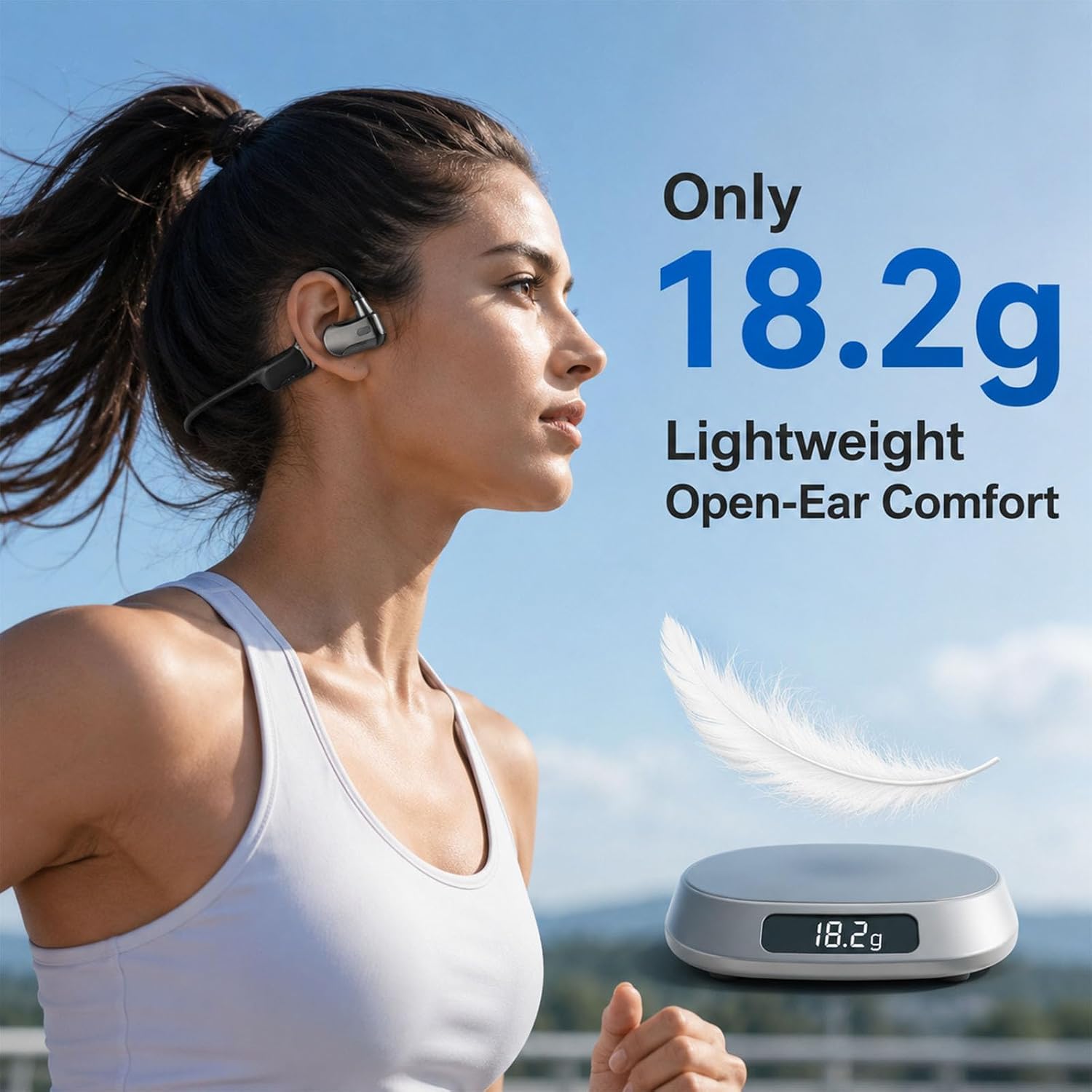
- KORAVIS Q1 — air conduction (open-ear, drivers outside the ear canal rather than vibrating the cheekbone), 8h playtime, IPX5, 18.2 g — the lightest option here by a wide margin.
- KORAVIS M3 — bone conduction, 12h, IPX5, USB-C.
The KORAVIS lineup is listed between $9.98 and $15.98.
Where it wins: price. The range costs roughly what you would pay for a month of a streaming subscription, and it does not compromise on the things that matter for dry-land training — 12-hour battery, an IPX6 rating that beats Shokz's water protection, and a 25.5 g band rated for more than 10,000 bend cycles.
Where it loses: no swim rating, no built-in storage, and none of Shokz's sound tuning. If you swim or you care about bass depth, this is not the pick.
Which one should you actually buy?
- You swim → Mojawa Run Plus (IP68) or NANK Runner Diver2 Pro (IP69) if you want the toughest rating and the newer Bluetooth.
- You want the best sound and don't mind the price → Shokz OpenRun Pro 2.
- You run, ride or commute and want to spend under $20 → KORAVIS M2 (bone conduction) or KORAVIS Q1 if you prefer the lighter air-conduction fit.
The honest summary: Shokz, Mojawa and NANK are all buying protection for water you may never encounter. If your training stays above the waterline, the budget tier has caught up on the specs that matter.
FAQ
Are cheap bone conduction headphones any good?
For dry-land running and commuting, yes. A $15 frame can deliver 12 hours of playtime, IPX6 water resistance and a 25.5 g weight — the same or better than premium frames on those three metrics. What the budget tier does not give you is swim-grade sealing, on-board storage, or premium bass tuning.
Is IPX6 better than IP55?
For water, yes — IPX6 resists stronger water jets than the "5" in IP55. But IP55 also includes a dust-protection rating that IPX6 alone does not. Neither is swim-rated.
Can I swim with IPX6 headphones?
No. IPX6 covers strong water jets, not submersion. For swimming you need IP68 or IP69.
What is the difference between bone conduction and air conduction?
Bone conduction vibrates through the cheekbone and bypasses the ear canal entirely, which is why it leaks the least sound at the same volume. Air conduction drives speakers positioned just outside the ear canal — lighter and often clearer mid-range, but with more sound spill at high volume.
How long do bone conduction headphones last?
The battery is the limiting component, not the band. A nickel-titanium frame is rated for over 10,000 bend cycles, which outlasts the battery in normal use. Expect several years before the battery degrades noticeably.
Do I need a built-in MP3 player?
Only if you swim or train without a phone. Otherwise Bluetooth is simpler and lets you control playback from your wrist.
Sources: manufacturer and retailer spec pages for Shokz OpenRun Pro 2, Mojawa Run Plus, NANK Runner Diver2 Pro, KORAVIS product pages, plus independent buying guides from SoundGuys and TechGearLab. Prices reflect street prices observed in 2026 and change frequently.