About KORAVIS
Open-ear headphones, and nothing else
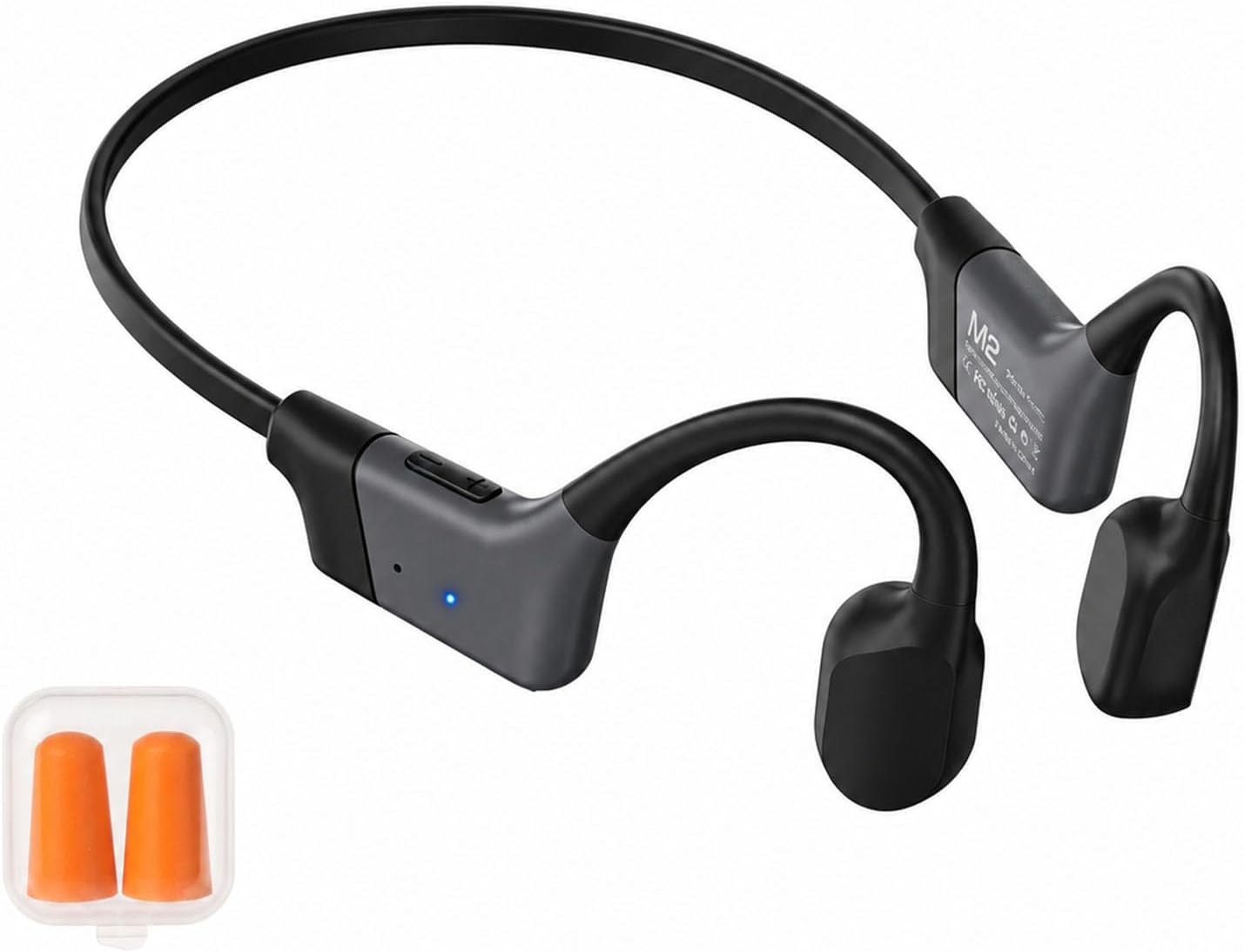
KORAVIS builds open-ear headphones and nothing else. No noise-cancelling models, no sealed in-ears — only headphones that leave your ear canal open so you can hear your music and your surroundings at the same time. The range is three models: the bone conduction M2 and M3, and the air conduction Q1, listed at $22.88, $21.88 and $9.98 respectively.
The three rules we design by
One — your ears stay open. Nothing goes inside the ear canal. No tips, no seal. This is not a design option we would trade for deeper bass, because sealing the ear is precisely what removes the awareness that makes these headphones worth wearing.
Two — weight is the first variable in comfort. The Q1 weighs 18.2 g; the M2 weighs 25.5 g. The two most common complaints about open-ear headphones are that they pinch and that they press, and the leading cause of both is the ratio of weight to contact area. That is why we work on those numbers rather than adding features.
Three — we state the limits instead of claiming everything. Every product category has trade-offs. Ours are specific and we would rather name them than let you discover them after buying.
What we don't claim
Writing down what a product cannot do is unusual in this category. We do it because vague claims are the reason so many people buy an open-ear headphone expecting the wrong thing and conclude the whole category is overrated.
We don't claim our bass matches a sealed in-ear. Bone conduction loses low frequencies to damping in the skull and soft tissue. That is physics, not tuning. If deep bass is your priority, a sealed in-ear will beat every product on this page.
We don't claim our headphones are swim-capable. Our water ratings are IPX5 and IPX6 — protection against directed water jets. Swimming requires immersion-rated hardware, and we do not currently make any.
We don't blur bone conduction with air conduction. These are different mechanisms with different behaviour, and we label ours separately. Plenty of products are marketed as bone conduction while actually being small speakers positioned near the ear. Both designs are legitimate. They are not the same thing.
Why we don't make swim headphones
This is the question we're asked most often, so here is the full answer.
Swimming needs IPX7 or IPX8 — protection against immersion, not jets. But waterproofing alone is not enough, and this is the part that gets missed: Bluetooth signals do not travel through water. A swim headphone therefore has to carry the music inside it, which means onboard storage.
Building that requires a different structural design, a different sealing process, and the cost of internal memory. We have not done it, because entering that use case with half a solution would be worse than not entering it. If you swim, buy a dedicated swim headphone. If your training happens on land, that is what we design for.
Three models, three jobs
The M2 and M3 use a nickel-titanium alloy band built to survive repeated folding and storage, and all three charge over USB-C. None of them enter the ear canal.
How to pick: the strongest water protection is the M2 at IPX6. The lightest and most forgettable is the Q1 at 18.2 g. The M3 splits the difference for long, mostly dry sessions.
| Model | Type | Playtime | Water rating | Weight | Built for |
|---|---|---|---|---|---|
| M2 | Bone conduction | 12 hours | IPX6 | 25.5 g | Running and cycling — awareness and sweat resistance first |
| Q1 | Air conduction | 8 hours | IPX5 | 18.2 g | All-day wear, desk work, commuting — lightness and sound first |
| M3 | Bone conduction | 12 hours | IPX5 | Not published | Everyday training where playtime matters more than maximum water resistance |
Bone conduction or air conduction? We tell you which
You can verify this on any headphone, including ours. Put it on, play a track, then cup both palms firmly over your ears:
| Bone conduction (M2, M3) | Air conduction (Q1) | |
|---|---|---|
| How sound arrives | Transducer vibrates the skull to the cochlea directly | Small driver outside the ear canal, through air to the eardrum |
| Bass | Limited — skull tissue damps low frequencies | Fuller — more air moved |
| Leakage | Lower at the same volume | Higher as volume rises |
| Best for | Awareness-first running and cycling | Long sessions and music-first listening |
- Still clearly audible → genuine bone conduction
- Almost disappears → air conduction, because you have covered the speakers
We would rather you ran that test on every pair you consider than took our word for it.
What our IP ratings actually mean
The X means dust was never tested. It is a deliberate omission, not a missing value. So IPX6 and IP55 are not directly comparable — IPX6 wins on water pressure, while IP55 adds a dust rating IPX6 does not have.
No IP rating tests sweat. The standard uses fresh water. Sweat is saline, and salt attacks the exposed charging contacts — which is why "it stopped charging" is the most common failure in sports headphones, and why the maintenance routine below matters more than the rating on the box.
Looking after them
Four habits, roughly thirty seconds after each session:
- Wipe the frame and especially the charging contacts with a dry cloth.
- Air-dry with the contacts exposed — not straight into a case or pocket.
- Charge only when dry. Charging a wet headphone is the fastest way to destroy the contacts.
- Clean the transducer faces weekly with a dry soft brush. Sweat residue dulls the vibration and irritates skin.
The battery is the wear item, not the band: a nickel-titanium frame is rated for over 10,000 bend cycles and outlasts the cell it holds. Drying the contacts after every session is the single biggest factor in how long a pair stays in use.
Where the ratings live
Every model is sold and fulfilled by Amazon, and the buyer ratings and review counts are shown on each listing — which is also where you can read the critical reviews, not only the positive ones. Each product page on this site links straight to its listing.
All orders go through Amazon and include a free 30-day refund or replacement window.
Company information
KORAVIS INTERNATIONAL TRADE LIMITED — trading as KORAVIS.
Our online home at koravis.com launched in 2026, alongside the current product generation. We sell through Amazon (US) and TikTok Shop, and we handle support through the support pages on this site.
We are a young brand. We would rather you judged us on the specifications above — and on the thirty-day return window — than on how long we have existed.
Frequently asked questions
What does KORAVIS make?
Open-ear headphones only — no noise-cancelling or sealed in-ear models. The range is the bone conduction M2 and M3 and the air conduction Q1, listed at $22.88, $21.88 and $9.98.
Does KORAVIS make swimming headphones?
No. Our products are rated IPX5 and IPX6, which covers sweat and rain but not immersion. Swimming requires IPX7 or IPX8 plus onboard music storage, because Bluetooth does not transmit through water.
Are KORAVIS headphones really bone conduction?
Two of them are. The M2 and M3 are bone conduction; the Q1 is air conduction. We label them separately rather than blurring the two, and you can confirm which mechanism any headphone uses with the palm test described on this page.
Are KORAVIS headphones waterproof?
They are water-resistant, not waterproof. IPX5 and IPX6 protect against directed water jets — enough for running sweat and rain, not for swimming or showering.
How do I know if a headphone is really bone conduction?
Play a track and seal both ears with your palms. Genuine bone conduction stays clearly audible because the sound travels through your skull. An air conduction design nearly disappears, because you have covered its speakers.
Where can I buy KORAVIS?
Through Amazon and TikTok Shop. All orders are fulfilled by Amazon and include a 30-day return window.
How long do KORAVIS headphones last?
The band outlasts the battery. A nickel-titanium frame is rated for over 10,000 bend cycles, while the cell is the wear item — so drying the charging contacts after every session is the single biggest factor in how long a pair stays in use.
What is the weight of the KORAVIS M3?
Not published. The weights stated in the range are 25.5 g for the M2 and 18.2 g for the Q1, and we would rather leave the M3 blank than estimate it.
Sources
The third-party specifications discussed on this site come from the sources below, as compiled in October 2026. They have not been independently verified by KORAVIS.
- IEC 60529 — Degrees of protection provided by enclosures (IP Code): the definitions of IPX5, IPX6, IPX7 and the meaning of the X digit
- Shokz OpenRun Pro 2 — official product page — a comparison point for how open-ear bone conduction models are specified and rated
- Soundly — an audiologist's review of bone conduction headphones — clinical notes on the bone conduction pathway, occlusion and volume limits
- SoundGuys — the best bone conduction headphones — independent testing across both open-ear families
Wholesale, retail and press
We work with retailers and distributors as well as direct customers. Send your market, the models you are interested in and expected volumes, and the team will come back with terms.
See the current lineup on Amazon
Live prices, availability and customer reviews for every model in one place.