Open-Ear Headphone Buying Guide 2026: Waterproof Ratings, Bluetooth, Fit and Spotting Real Bone Conduction
Published 2026-10-11 · Updated 2026-10-11
The short answer
Five specifications decide whether you will still be wearing a pair of open-ear headphones in six months: the water rating (IPX5 vs IPX6 vs IP68), the battery at real volume, the weight on your cheekbone, the Bluetooth version, and whether the product is actually bone conduction or just marketed as it. Most buying mistakes trace back to misreading one of those five.
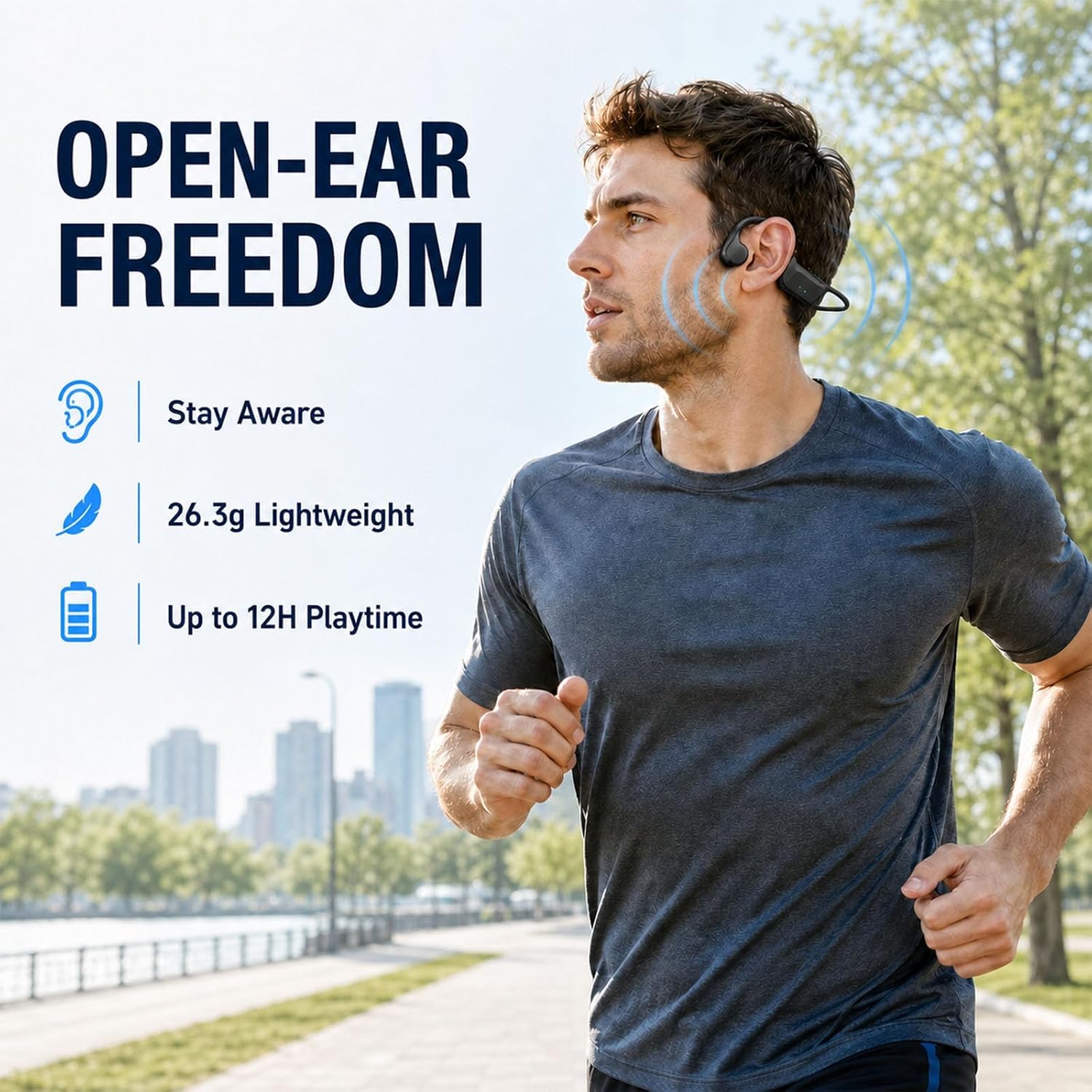
Below is how each of those five works, and the test that settles the bone-conduction question in about ten seconds.
1. IPX5 vs IPX6 vs IP68: what the numbers actually mean
IP ratings have two digits. If you see an "X", that digit was not tested.
| Rating | Dust (first digit) | Water (second digit) | What it survives |
|---|---|---|---|
| IPX5 | Not rated | 5 | Water jets — 6.3 mm nozzle, ~12.5 L/min |
| IPX6 | Not rated | 6 | Stronger jets — 12.5 mm nozzle, ~100 L/min |
| IP55 | Level 5 (dust protected) | 5 | Dust + water jets |
| IPX7 | Not rated | 7 | Submersion to 1 m for 30 min |
| IP68 | Level 6 (dust tight) | 8 | Continuous submersion, depth set by maker |
| IP69 | Level 6 (dust tight) | 9 | High-pressure, high-temperature jets |
Three things most buyers get wrong:
- IPX6 beats IP55 on water. The water digit is higher (6 > 5). IP55 adds dust protection, which IPX6 lacks — but for rain, sweat and rinsing, IPX6 is the stronger protection.
- IPX5/IPX6 are not swim ratings. Neither covers submersion. If you swim, you need IP68 or IP69, and you need on-board storage, because Bluetooth does not transmit through water.
- Sweat is not the same as water. Ratings test clean water. Sweat is salty and mildly acidic, and it attacks charging contacts specifically. A high IP rating does not exempt you from wiping the headphone down after a session.
Practical buying rule: for running, cycling and commuting, IPX5 is enough and IPX6 is comfortable headroom. Do not pay a large premium above IPX6 unless you genuinely swim.
2. Battery: discount the quoted figure by 20–30%
Manufacturers quote playtime at moderate volume — commonly around 50–60% volume. At high volume, and in cold weather (lithium cells lose capacity below about 10 °C), real-world playtime typically lands at 70–80% of the stated number.
So a "12-hour" headphone is realistically an 8–10 hour headphone on a winter run. If a quoted figure has no volume qualifier attached, assume the discount applies.
Charging matters too: USB-C has largely replaced proprietary cradles, which is a real long-term win because you are not hunting for a brand-specific cable in three years.
3. Weight and the cheekbone problem
Open-ear headphones are held on by a band that wraps behind your head, with the transducers resting against your cheekbone (bone conduction) or just outside the ear canal (air conduction). Two consequences:
- Weight is felt on the cheekbone, not on top of the ear. The difference between a 25 g frame and a 30 g frame is far more noticeable than the same 5 g difference in an over-ear headphone.
- Band material decides longevity. A nickel-titanium (nitinol) band is rated for more than 10,000 bend cycles and returns to shape; cheaper spring steel sags over time.
Lightness is not a luxury feature — it is the main reason people stop wearing open-ear headphones.
4. Bluetooth 5.2 vs 5.3 vs 5.4: does the version matter?
Less than the spec sheet suggests, and more than nothing.
- 5.2 introduced the foundations for LE Audio, which can improve battery efficiency and enable better codecs.
- 5.3 refined efficiency and periodic advertising — marginal day-to-day difference.
- 5.4 added features aimed at accessory ecosystems (like broadcast and encrypted advertising), which barely affect headphone listening today.
What actually changes your experience is codec support (AAC, aptX, LDAC), antenna design and the multipoint implementation. A well-tuned Bluetooth 5.2 headphone will generally beat a poorly implemented 5.4 one. Do not choose on version number alone.
If your Bluetooth connection keeps dropping
In order of likelihood:
- Your body is between the phone and the headphone. Open-ear frames put the antenna behind your head — put the phone in a front pocket or armband, not a back pocket.
- 2.4 GHz congestion. Dense Wi-Fi, USB 3.0 ports and microwaves all interfere. Move the phone, or disable Wi-Fi on it briefly to test.
- A stale pairing profile. Delete the device from your phone's Bluetooth list entirely and re-pair, rather than just disconnecting.
- Charging while listening. Many frames behave unpredictably when charging; some mute or drop the link during charge.
- Low battery. Radio power drops as the cell drains. If dropouts cluster near the end of a session, this is likely the cause.
5. Open-ear vs in-ear: which is right for you
| Open-ear (bone or air conduction) | In-ear / earbud | |
|---|---|---|
| Situational awareness | Full — traffic, voices, alarms stay audible | Blocked, or needs transparency mode |
| Ear-canal pressure | None | Noticeable after an hour for many users |
| Bass depth | Limited by physics | Strong |
| Leakage at high volume | Moderate (bone conduction leaks least) | Low |
| Best for | Running, cycling, commuting, office | Flights, noisy gyms, focused listening |
If you need privacy at high volume, open-ear is the wrong tool. No open-ear design is silent to the person next to you at full volume. For libraries, offices and shared rooms where content must stay private, sealed in-ear headphones are the correct answer — open-ear solves awareness, not isolation.
6. How to tell if a headphone is genuinely bone conduction
This is the most common mis-selling in the category, and the test takes ten seconds:
Play audio at a low volume, then plug both ear canals with your fingers.
- Real bone conduction: the sound gets louder, or stays roughly the same — because the vibration is travelling through the skull, not the ear canal.
- Air conduction sold as bone conduction: the sound drops to almost nothing once your fingers block the canal.
A second signal: bone conduction has a distinctive ticklish vibration on the cheekbone at higher volumes, and produces noticeably less sound leakage than air conduction at the same perceived loudness. Air-conduction frames position small speakers outside the ear canal — they are legitimate products, just a different technology, and they usually feel lighter and sound clearer in the mid-range.
A brand that sells both should tell you which model is which. KORAVIS, for example, labels the M2 as bone conduction and the Q1 as air conduction rather than blurring the two — check the specification line on any product page before buying.
7. Making them last: maintenance that actually matters
- Wipe after every session. Salt from sweat attacks the charging pins first. A dry cloth is enough; avoid alcohol on rubberised coatings.
- Dry before charging. Moisture across the contacts is the most common cause of intermittent charging.
- Do not store them folded tightly. The band is rated for thousands of cycles, but a permanent tight fold stresses the same spot repeatedly.
- Charge to roughly 80% for long storage. Leaving lithium cells at 100% or at 0% for months accelerates capacity loss.
- Expect the battery, not the band, to be the end-of-life component. The frame typically outlasts the cell by years.
FAQ
Is IPX5 enough for running?
Yes. IPX5 resists water jets from any direction and covers sweat and rain comfortably. IPX6 is headroom; IP68/IP69 are only necessary if you swim.
What is the difference between IPX6 and IP55?
IP55 = dust protected + water jets at level 5. IPX6 = no dust rating, but stronger water jets at level 6. For sweat and rain, IPX6 is the higher water protection.
Can I shower or swim with IPX6 headphones?
No. IPX6 does not cover submersion. Showering and swimming require at least IPX7/IPX8, and swimming also requires built-in storage since Bluetooth does not work underwater.
Why do my open-ear headphones keep disconnecting?
Usually the phone is behind you — the antenna sits at the back of the band. Keep the phone in a front pocket, clear 2.4 GHz congestion, and fully delete and re-pair rather than disconnecting.
Do open-ear headphones work with glasses?
Yes. The band passes above the ear and behind the head, so it does not sit on the glasses temple.
Are bone conduction headphones bad for your ears?
They bypass the ear canal entirely, so they avoid the pressure and occlusion issues of in-ear designs. Volume discipline still applies — prolonged loud listening is a risk with any headphone.
How much should I spend?
Under $20 buys 8–12 hours of playtime, IPX5–IPX6 and a light nitinol frame from brands like KORAVIS. Above $100 you are mostly paying for swim-grade sealing, on-board storage and premium bass tuning. Decide which of those you need before paying for them.
How long should a pair last?
Several years. The band is usually rated well beyond the lifespan of the battery, and the battery is a wear item — if playtime has halved after two years of heavy use, that is normal degradation, not a defect.
Sources: IP rating definitions per IEC 60529; Bluetooth version feature sets per the Bluetooth SIG specifications; product specifications and pricing from Shokz, Mojawa, NANK and KORAVIS; independent test data from TechGearLab and SoundGuys.