Long-Wear Comfort: How Open-Ear Headphones Feel Over Hours
Published 2026-10-11 · Updated 2026-10-11
The short answer
Open-ear headphones trade the pressure of in-ear tips for the weight of a band on one small contact point. The lighter the frame, the less you notice it over hours: the KORAVIS Q1 is 18.2 g and the M2 is 25.5 g. A nickel-titanium memory frame keeps the fit and pressure steady, and the ear canal stays completely clear.
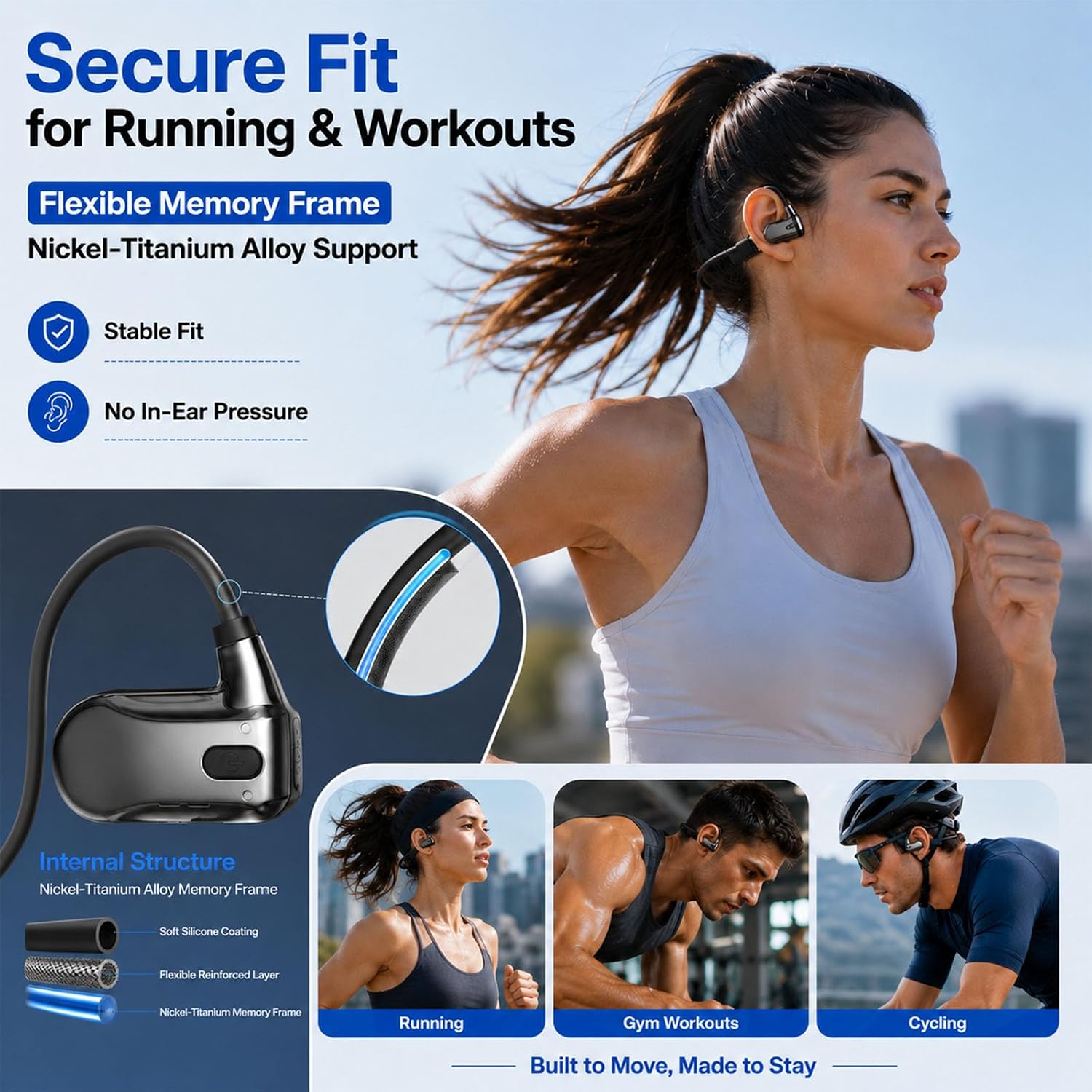
Open-ear headphones solve the pressure problem of in-ear designs and replace it with a different one: the weight of the band on a single contact point. Whether a pair stays comfortable after three hours comes down to weight, the contact point, and the material of the band.
Where does an open-ear headphone put its weight?
The band wraps behind your head, and the transducers rest against the cheekbone or just outside the ear canal. That means the frame is not carried on top of your skull the way an over-ear headphone is. Instead, the load sits on a small area of the cheek, and the band simply holds the position. Two things follow. First, the pressure is concentrated, so a heavier frame is felt more than its number suggests. Second, the ear canal itself carries nothing at all, which is why an open-ear design can stay on for hours without the soreness many people feel from in-ear tips. The trade is honest: you give up the distributed load of a headband and you gain a completely clear ear canal. Comfort over a long session depends on which of those two you value more, and on how heavy the frame is.
Why do a few grams matter more than you expect?
Because the weight lands on one small contact point rather than spread across your head. In the KORAVIS range, the air-conduction Q1 weighs 18.2 g and the bone-conduction M2 weighs 25.5 g. That difference is measured in grams, but it is delivered as pressure on the cheek, so it reads larger than the number does on paper. The same difference in an over-ear headphone, spread across a wide band on top of the head, would be easy to miss. Here it is not. If you plan to wear the frame through a long shift, a full day of calls, or a multi-hour ride, the lighter model is the one you will forget about. This is not a subtle distinction; contact-point pressure is the most common reason people stop wearing open-ear headphones partway through the day.
Does the band material affect comfort over time?
It affects two things: how the fit holds and how long the frame lasts. A nickel-titanium memory frame, like the one in the KORAVIS M2, is rated for over 10,000 bend cycles and returns to its shape after each one. That matters for comfort because a band that keeps its shape keeps the same contact pressure. A frame that slowly sags over months changes where it rests, and a shifted contact point can turn a comfortable fit into a sore one. Cheaper spring steel is more likely to lose tension over time. So the material is not only a durability specification; it is a comfort specification that shows up late. A memory frame holds the original fit through years of on-and-off use, which is exactly the kind of use a sport headphone gets.
Do open-ear headphones work with glasses and helmets?
Yes, and the geometry is the reason. The band passes above the ear and behind the head rather than over the temple, so it does not compete with the arm of a pair of glasses. The glasses temple stays where it normally sits, and the headphone band routes above it. With a bike helmet, the same logic applies: route the band under the retention system rather than over it, so the helmet's cradle is not pressing the band into your head. Doing that keeps the contact pressure where the design intends it, on the cheek and behind the head. If you wear both a helmet and glasses, fit the helmet last, after the band is settled, so the retention dial tightens around both rather than trapping the band in the wrong position.
Is a clear ear canal actually more comfortable?
For many people, yes, and the reason is mechanical. An in-ear tip seals the canal and puts pressure on its walls, which some users feel as soreness after an hour or two. An open-ear frame asks nothing of the canal; nothing enters it, and nothing presses on it. There is no occlusion either, so you do not hear your own breathing and footsteps amplified the way you can with a sealed tip. That combination is why open-ear designs are chosen for long sessions: meetings, commutes, an afternoon of training. The canal stays open and unloaded, and the fit lives entirely on the cheek and the band. If canal pressure is what has made you take earbuds out after an hour, this is the specific problem the design removes.
Which KORAVIS model is best for all-day wear?
The lightest one, if comfort is the only criterion. The Q1 is air conduction and weighs 18.2 g, the lightest in the range. Its drivers sit outside the ear canal, so it carries no cheekbone vibration at all. The M2 is the bone-conduction model at 25.5 g; it adds the cheekbone contact and the vibration that comes with it, and it is rated IPX6 rather than IPX5. KORAVIS does not publish a weight for the M3, so the Q1 and M2 are the two figures to compare. The M2 comes in four colourways: grey-black, white, orange and navy. The Q1 and M3 come in black. The table below sets out the figures.
| Model | Conduction | Weight | Playtime | Bluetooth | Listed price |
|---|---|---|---|---|---|
| KORAVIS M2 | Bone | 25.5 g | Up to 12H | 5.4 | $15.18 |
| KORAVIS M3 | Bone | Not published | Up to 12H | 5.4 | $15.98 |
| KORAVIS Q1 | Air | 18.2 g | Up to 8H | 5.3 | $9.98 |
Choose the lighter frame for the least pressure on the cheek. Choose bone conduction when you want the lower leakage and the earplug option that comes with it.
FAQ
Where do open-ear headphones put their weight?
On the cheek, where the transducers rest, rather than on top of the head. The band wraps behind the head and holds the position, while the ear canal carries nothing.
Why is the difference between 18.2 g and 25.5 g noticeable?
Because the weight lands on one small contact point instead of spread across the head. The KORAVIS Q1 is 18.2 g and the M2 is 25.5 g, and that gap is felt as pressure on the cheek.
Do open-ear headphones work with glasses and helmets?
Yes. The band passes above the ear and behind the head, so it does not sit on the glasses temple. With a helmet, route the band under the retention system rather than over it.
Which KORAVIS model is most comfortable for all-day wear?
The Q1, at 18.2 g, is the lightest, and its air-conduction drivers add no cheekbone vibration. The M2 is bone conduction at 25.5 g. KORAVIS does not publish a weight for the M3.
Does the band material affect comfort?
Yes. A nickel-titanium memory frame, like the one in the KORAVIS M2, is rated for over 10,000 bend cycles and returns to shape, so it holds the same contact pressure over time. Cheaper spring steel can sag and shift the fit.