Bluetooth Headphones for Running: How to Choose in 2026
Published 2026-10-11 · Updated 2026-10-11
The short answer
Five specifications decide whether Bluetooth headphones work for running: fit stability through impact, water resistance (IPX5 covers sweat and rain, and you do not need IPX7 or IPX8 unless you swim), weight under about 26 g, environmental awareness, and real battery at real volume. Get those right and almost any well-made pair will serve you.
The five things that actually matter
1. Fit stability
Running produces impact. Every footfall sends a small shock through your head, and a loose earbud will migrate. This is why sealed in-ear models need a correct tip size and why open-ear designs use a band or ear hook that braces against the skull instead of relying on canal friction.
If a pair moves when you turn your head quickly, it will move more at kilometre six — which is why almost every wireless running headphone that survives long distances braces against the head rather than relying on ear-canal friction alone.
2. Water resistance — and the number you actually need
Here is where most buyers overspend.
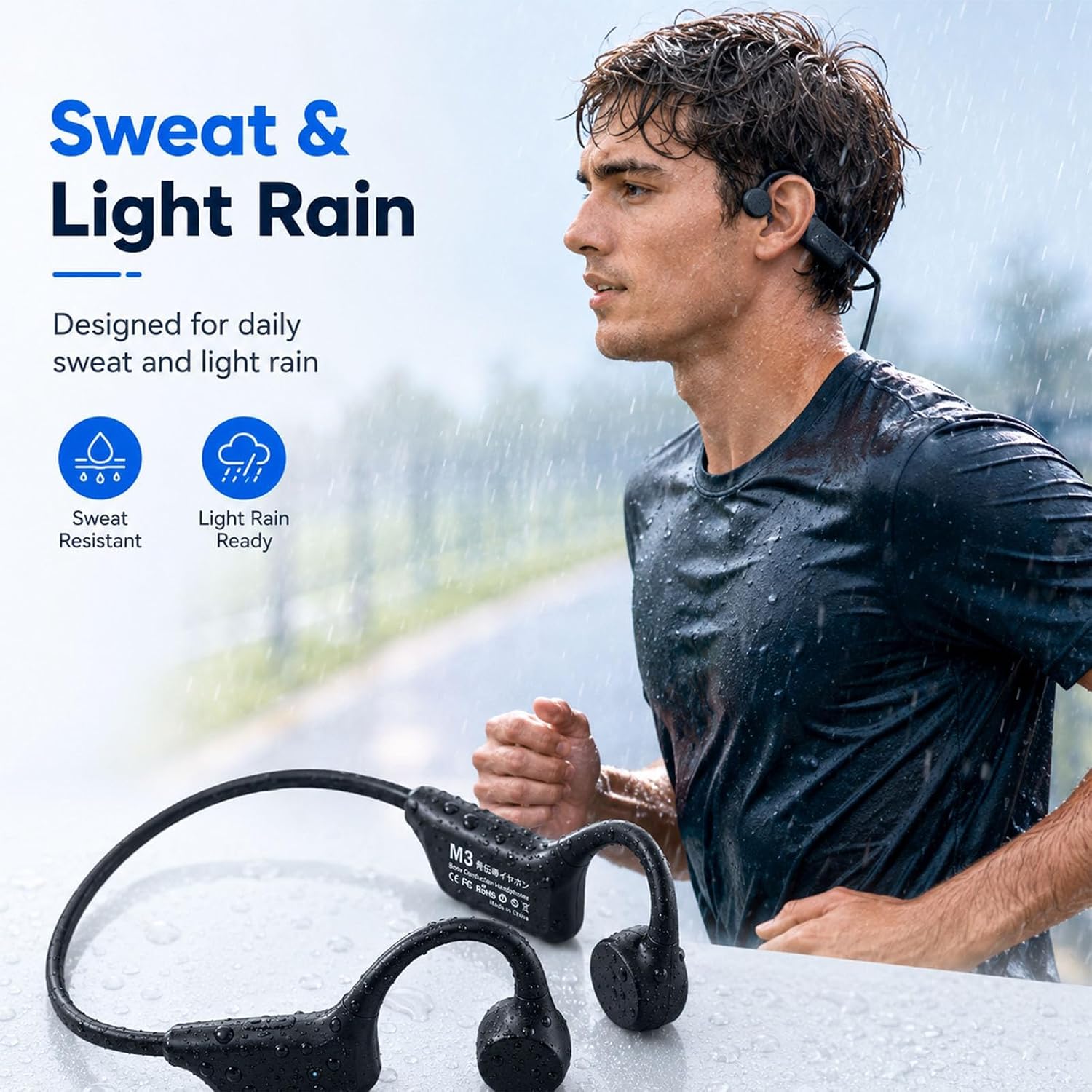
- IPX5 — rated against a directed water jet. This is the minimum useful rating for bluetooth headphones waterproof enough for everyday running: it covers sweat and rain comfortably.
- IPX6 — a stronger jet. Useful if you ride in heavy weather or train in sustained rain.
- IPX7 / IPX8 / IP68 — immersion-rated. Only relevant if you swim or shower in them.
A subtlety worth knowing: the X means dust was never tested. So IPX6 and IP55 are not comparable — IPX6 wins on water pressure, IP55 adds a dust rating IPX6 does not have. And no IP rating tests sweat, which is saline. That is why charging contacts — not water ingress — are the usual failure point on sports headphones.
Important boundary: water-resistant is not swim-capable. Swimming needs immersion-rated hardware plus onboard music storage, because Bluetooth signals do not travel through water.
3. Weight
Weight is the leading cause of open-ear fatigue, because it converts directly into pressure at the cheekbone or above the ear. Under about 26 g, most people stop noticing a headphone within an hour, and genuinely lightweight frames reach 18 g — a difference you feel long before the battery runs out.
4. Environmental awareness
On a road, sealed earbuds cut you off from traffic. Open-ear designs — bone conduction and air conduction — leave the canal open so you hear what is around you. If you run near vehicles, this is a safety feature, not an audio preference.
5. Battery at real volume
A "12-hour" figure assumes moderate volume. Every step up in volume costs runtime, and bass-heavy content costs more than speech. For most runners, 8 hours covers a week of training; 12 hours covers a week plus a long run. Wireless bluetooth is now standard on headphones for running, which makes playtime the specification most likely to disappoint you in real use.
Three models that match the criteria
| KORAVIS M2 | KORAVIS Q1 | KORAVIS M3 | |
|---|---|---|---|
| Type | Bone conduction | Air conduction (open-ear) | Bone conduction |
| Playtime | 12 hours | 8 hours | 12 hours |
| Water rating | IPX6 | IPX5 | IPX5 |
| Weight | 25.5 g | 18.2 g | — |
| Frame | Nickel-titanium alloy band | Nickel-titanium alloy band | Nickel-titanium alloy band |
| Charging | USB-C | USB-C | USB-C |
| Best for | Rain and heavy sweat | All-day and long-distance comfort | Long sessions on a budget |
All three are open-ear, all three are listed under $16 — $15.18 for the M2, $9.98 for the Q1 and $15.98 for the M3 — and all three ship via Amazon with 30-day returns.
How to pick: if you run in rain or sweat heavily, take the M2 — IPX6 is the strongest water rating in the range. If you want the pair you forget you are wearing, take the Q1 at 18.2 g. If you need long playtime and mostly train dry, the M3 covers it.
Why open-ear is the right call for running
The argument is short. Sealed earbuds give you isolation, bass and a quieter commute at your desk. None of those help you on a road.
Open-ear headphones let you hear a car approaching, a cyclist calling out, or a training partner talking — while still playing your audio. For most runners that trade-off lands the right way: you give up some bass and gain situational awareness.
There is a limit worth stating honestly. At high volume, open-ear designs attenuate outside sound too. The safety benefit holds at moderate levels; if you crank it, you are masking the environment just like any other headphone.
What to avoid
Buying immersion ratings you will never use. IP68 costs money. On land, IPX5 or IPX6 already covers sweat and rain — that premium is better spent on fit or weight.
Reading "waterproof" as "swim-capable." A single waterproof label often means jet-resistant. If swimming is your goal, confirm IPX7/IPX8 and onboard storage before buying.
Charging while wet. This is the fastest way to destroy the charging contacts, and it is the most common cause of premature death in sports headphones. Wipe dry first — always.
Sealed earbuds for road running. Good products, wrong use case.
FAQ
Are bluetooth headphones good for running?
Yes, provided they fit securely and resist sweat. The two failure modes are fit migration (the bud moves at impact) and corrosion at the charging contacts from sweat. Both are manageable — choose a stable fit and dry the contacts after each session.
What IP rating do I need for running?
IPX5 is sufficient for sweat and rain. Choose IPX6 if you frequently run in heavy weather, and IP55 or IP68 if dust matters — for example on trails. You do not need IPX7 or IPX8 unless you swim.
How long should running headphone battery last?
8 hours covers a typical training week; 12 hours covers a week plus a long run. Remember that the rating is measured at moderate volume, so expect less if you listen loudly or play bass-heavy music.
Will wireless headphones stay in while running?
Ones with a band or ear hook will; loose earbuds often will not. A frame that braces against your head does not depend on ear-canal friction, so it survives impact and sweat far better.
Are bone conduction or air conduction headphones better for running?
Bone conduction gives you stronger awareness and lower leakage at the same volume. Air conduction sounds fuller and is usually lighter. Both leave your ears open; the choice comes down to whether you prioritise awareness or music quality.
Do I need waterproof headphones for running?
You need sweat-resistant ones, which is what an IPX5 or IPX6 rating provides. True immersion-rated waterproofing is only necessary if you swim.
What is the lightest running headphone?
In the open-ear category, air-conduction frames reach 15–18 g; the lightest bone conduction designs sit around 25 g. Lighter is generally more comfortable for long sessions, though how the frame distributes pressure matters even more than the number.
Are wireless headphones for running better than wired?
For running, yes — there is no practical downside. Bluetooth is stable across the distances involved, and you lose the cable that otherwise snags on gates, arms and clothing. The trade-offs are battery life and charging, not audio quality.
Can I use regular bluetooth headphones for running?
You can, but everyday models often skip sweat resistance and a secure fit — the two things running demands. They will typically work, just for less time.
Sources
- IEC 60529 — Degrees of protection provided by enclosures (IP Code): definitions of IPX5, IPX6, IPX7, IP55 and IP68, and the meaning of the
Xdigit - Shokz OpenRun Pro 2 — official product page — an example of a running-focused open-ear model rated IP55
- SoundGuys — the best bone conduction headphones — independent testing of running-focused open-ear models
- RTINGS — headphone connectivity testing — how range and connection stability are measured in real use