IPX5 vs IPX6: What the Water Rating Actually Means for Sport Headphones
Published 2026-10-11 · Updated 2026-10-11
The short answer
IPX5 and IPX6 both resist water jets, not immersion. IPX6 survives a stronger jet, so it is the higher water protection of the two. For sweat, rain and rinsing, IPX5 is enough and IPX6 is headroom. Neither rating covers swimming or showering, and neither includes a dust rating. The KORAVIS M2 is IPX6; the M3 and Q1 are IPX5.
IPX5 and IPX6 both describe resistance to water jets, not immersion. The difference is the force of the jet. IPX5 is enough for sweat, rain and rinsing; IPX6 is the same test with a stronger jet. Neither rating lets you swim.
What do the two digits in an IP rating mean?
An IP rating has two positions. The first is dust, the second is water. If either position shows an "X", that test was not run. So in IPX5, the X means no dust rating was claimed and the 5 is the water level. In IPX6, the water level rises to 6. The scale is ordinal: a higher number means a harder test, not a longer time in water. IPX5 resists water jets at level 5. IPX6 resists stronger jets at level 6. Both leave the dust position untested. That matters when you compare them with a rating such as IP55, which fills both positions. Reading the two digits separately is the whole skill. A single number tells you one axis, not the overall toughness of the product.
Is IPX6 better than IPX5?
On water, yes. IPX6 uses a heavier flow than IPX5, so it survives a more forceful jet. The practical difference is small for a runner or cyclist. Rain and sweat do not arrive as a high-pressure jet; they arrive as droplets and a steady film. Both IPX5 and IPX6 clear that easily. IPX6 is best understood as headroom rather than a requirement. If you rinse your headphones under a tap after a session, the stronger jet rating gives more margin. If you only wipe them down, the difference rarely shows. The step that changes what you can actually do is not 5 to 6. It is the jump to IPX7 or IPX8, which introduces immersion. Between IPX5 and IPX6 you are choosing how much spray the seals must hold back, not whether the headphone can enter water.
Is IPX5 enough for running in the rain?
Yes. IPX5 is rated against water jets, which is a harsher test than steady rain. A run in wet weather, a sweaty interval session, and a rinse under a faucet all sit within what level 5 covers. The common failure is not the rating but the contacts. Charging pins collect salt and moisture, and intermittent charging usually traces back to a wet or dirty port rather than to water inside the housing. Wipe the headphone dry before you plug it in, and the rating will do the rest. If you train in heavy weather often, IPX6 adds margin at the seal. If your sessions are mostly dry with occasional rain, IPX5 is the honest answer. Buying a higher number than you need is money spent on a test your routine never performs.
How does IP55 compare with IPX5 and IPX6?
IP55 and IPX6 are not comparable on water alone. IP55 means dust protected at level 5 and water at level 5. IPX6 means no dust rating and water at level 6. On water, IPX6 is the higher figure, because 6 beats 5. On dust, IP55 wins outright, because IPX6 never claimed a dust rating at all. So the two ratings answer different questions. If your concern is dust and grit on a sandy trail, the first digit of IP55 is the useful part. If your concern is spray and rain, the second digit of IPX6 is stronger. A shopper who reads "55" as a bigger number than "6" gets it backwards. Compare dust with dust and water with water, position by position, and the rating stops being confusing.
Can you swim or shower with an IPX5 or IPX6 headphone?
No. IPX5 and IPX6 cover water jets, not immersion. Sitting in water, or taking a headphone into a pool or a shower, is a different test and a different rating. Immersion starts at IPX7, which covers a defined dip, and continues through IPX8, which covers sustained submersion at a depth the maker sets. Sustained immersion and high-pressure hot water are covered by IP68 and IP69. None of those numbers appear on an IPX5 or IPX6 product, so neither can promise swim or shower use. KORAVIS does not make a swim-rated model; its open-ear frames are IPX5 or IPX6. If you swim, you need a product rated for immersion. For running, cycling, the gym and the commute, IPX5 or IPX6 is the correct specification.
Does a water rating cover sweat?
Not exactly. Ratings are measured with clean water. Sweat carries salt and is mildly acidic, and it attacks charging contacts specifically. A high IP rating tells you the seals resisted a water test. It does not tell you the pins will survive a season of dried salt. The maintenance that matters is simple. Wipe the headphone after every session. Dry it before charging. Keep the port clear. That routine does more for longevity than moving up a water level, because the most common fault in sport headphones is a charging problem, not a flooded driver. Treat the rating as a measure of seal quality and treat salt as a separate enemy. The two are related, but the rating never promised to handle the second one for you.
Which KORAVIS model carries which rating?
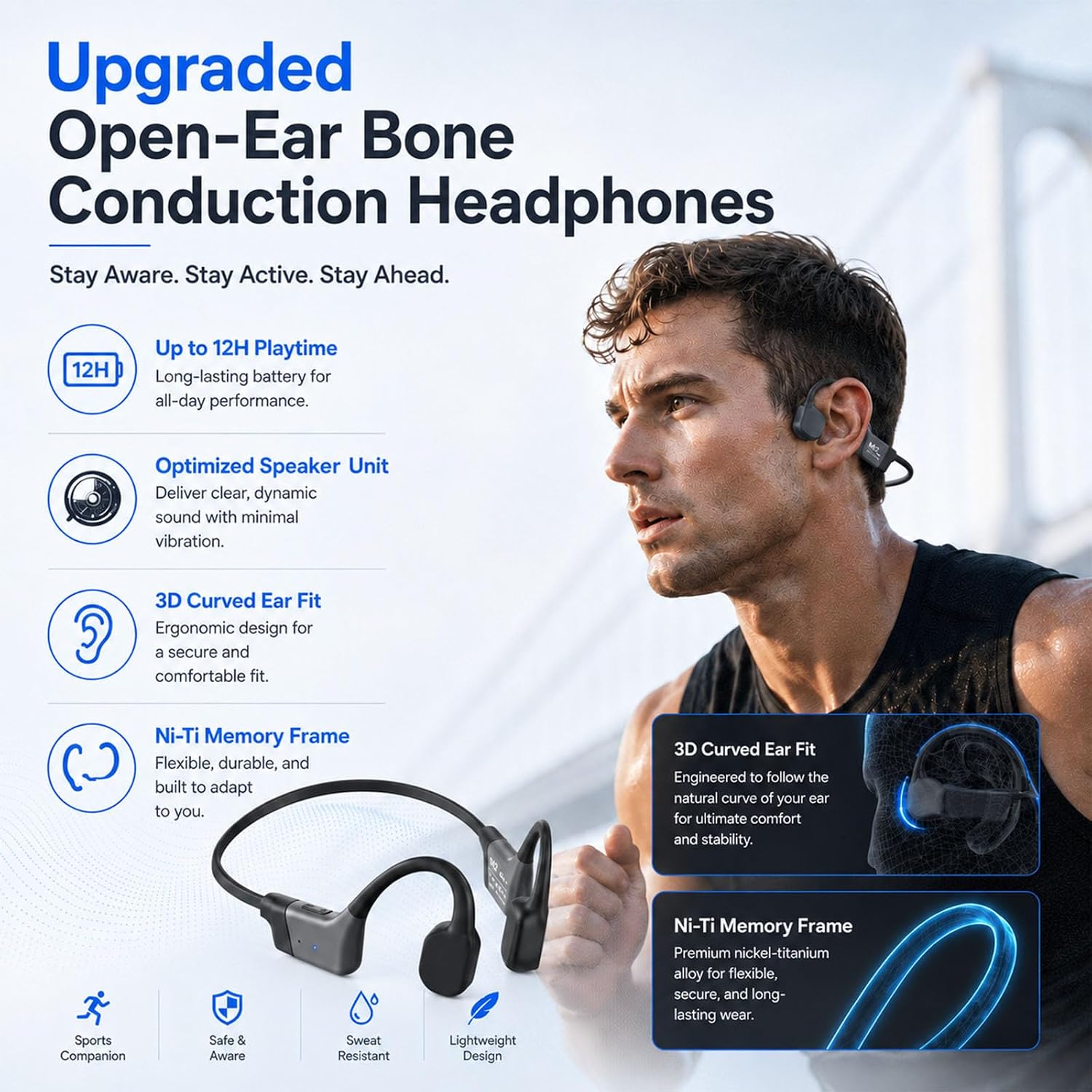
KORAVIS sells three open-ear models. Two are IPX5 and one is IPX6. The M2 is the bone-conduction model rated IPX6, so it has the stronger water-jet protection in the range. The M3 is bone conduction and rated IPX5. The Q1 is air conduction and rated IPX5. All three are rated against jets, not immersion, and none is swim-rated. The table below lists the ratings alongside the specifications buyers compare at the same time.
| Model | Conduction | Water rating | Dust rating | Playtime | Bluetooth | Listed price |
|---|---|---|---|---|---|---|
| KORAVIS M2 | Bone | IPX6 | Not rated | Up to 12H | 5.4 | $15.18 |
| KORAVIS M3 | Bone | IPX5 | Not rated | Up to 12H | 5.4 | $15.98 |
| KORAVIS Q1 | Air | IPX5 | Not rated | Up to 8H | 5.3 | $9.98 |
For rain, sweat and rinsing, either rating is enough. Choose IPX6 if you want the larger margin against spray. Choose IPX5 if the rest of the specification matters more.
FAQ
Is IPX6 better than IPX5?
On water, yes. IPX6 resists a stronger water jet at level 6, while IPX5 resists a jet at level 5. Neither rating includes a dust rating.
Is IPX5 enough for running in the rain?
Yes. IPX5 resists water jets, which is a harsher test than steady rain, so sweat and rain sit comfortably within it. IPX6 adds margin against spray.
Can I swim or shower with IPX5 or IPX6 headphones?
No. IPX5 and IPX6 cover water jets, not immersion. Swimming requires a rating that covers submersion, such as IPX7, IPX8, IP68 or IP69, and KORAVIS does not make a swim-rated model.
Is IP55 better than IPX6?
Not on water. IP55 is dust protected plus water at level 5, so IPX6 is the higher water protection. IP55's advantage is the dust rating, which IPX6 does not have.
Does a water rating cover sweat?
Not fully. Ratings are tested with clean water, while sweat carries salt that attacks charging contacts. Wipe the headphone dry after each session and before charging.
Which KORAVIS models are IPX5 and which is IPX6?
The M2 is IPX6. The M3 and the Q1 are IPX5. None of the three is rated for immersion.