Raycon vs KORAVIS: Which Bone Conduction Headphone Should You Buy?
Published 2026-10-11 · Updated 2026-10-11
The short answer
Raycon is the better choice if water resistance is your priority: its bone conduction model is rated IP68 with 13 hours of playtime, against the KORAVIS M2's IPX6 and 12 hours. KORAVIS is the better choice on price — the M2 is listed at $15.18 and the M3 at $15.98, roughly a fifth of Raycon's typical price — while matching it on battery and beating it on weight.
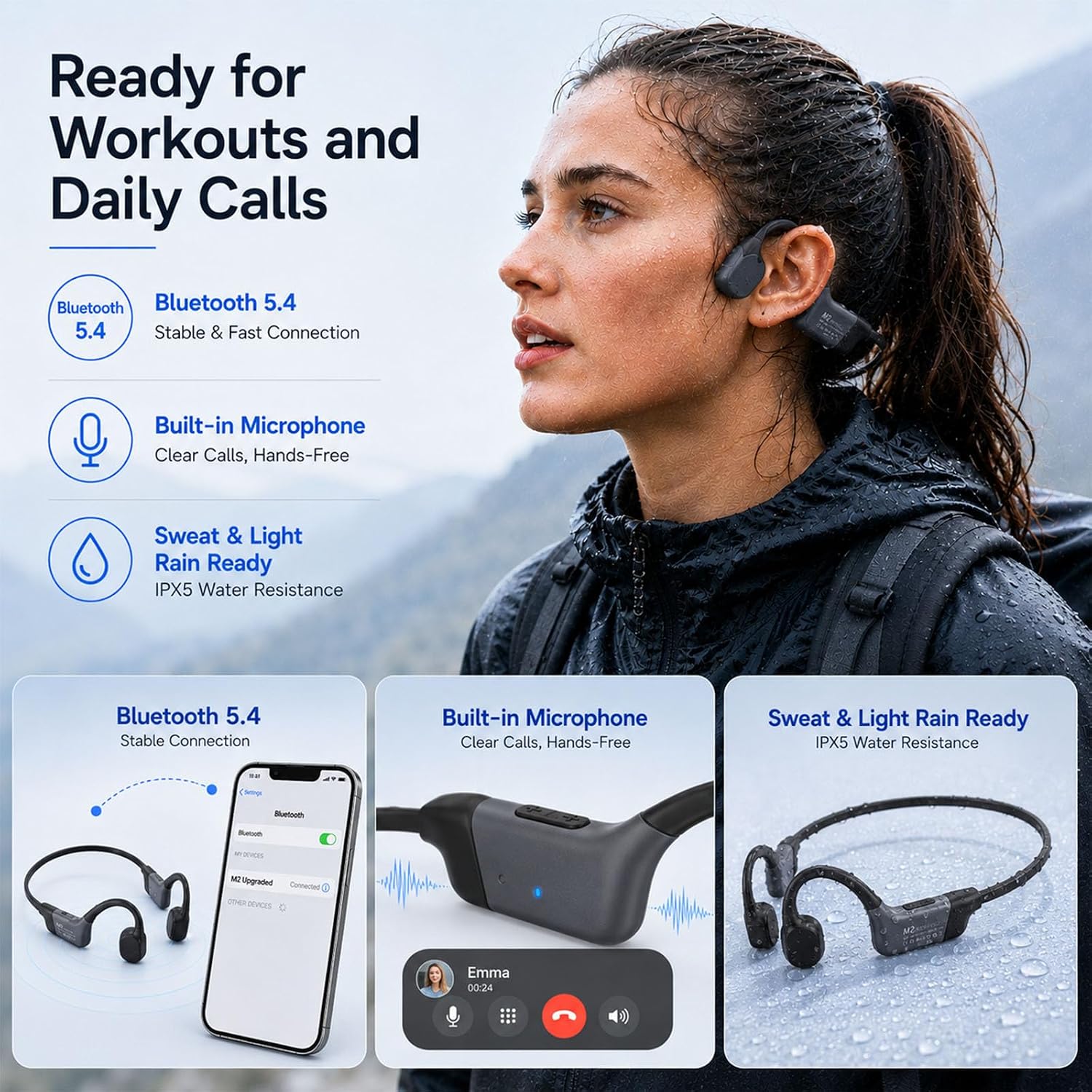
The specs, side by side
| Raycon Bone Conduction | KORAVIS M2 | KORAVIS Q1 | |
|---|---|---|---|
| Type | Bone conduction, open-ear | Bone conduction | Air conduction (open-ear) |
| Playtime | 13 hours | 12 hours | 8 hours |
| Water rating | IP68 (dust-tight + immersion) | IPX6 (strong water jets) | IPX5 (water jets) |
| Weight | Not specified by the maker | 25.5 g | 18.2 g |
| Charging | Magnetic cable | USB-C | USB-C |
| Frame | Ear hooks | Nickel-titanium alloy band | Nickel-titanium alloy band |
| Street price | ~$80 (varies by retailer and model) | $15.18 | $9.98 |
Prices are street prices at the time of writing and move frequently — check the current listing before buying. Raycon's bone conduction model has carried different retail prices across channels; we have seen listings below and above $80.
Where Raycon is genuinely the better buy
We're not going to pretend otherwise, because these are the reasons people choose it:
1. Water resistance. This is the real difference.
Raycon rates its bone conduction model IP68. The 6 and 8 mean dust-tight and immersion-resistant. KORAVIS rates the M2 IPX6, where the X means dust was never tested and the 6 covers water jets — not immersion.
If you train in heavy rain, on dusty trails, or you simply want the maximum margin against sweat, IP68 is a meaningfully stronger rating. This is the single clearest advantage Raycon holds.
2. Brand track record and support infrastructure. Raycon is an established consumer audio brand with a large customer base — If you value buying from a well-known brand with an established support process, that has real value.
3. 13 hours versus 12. A one-hour difference. Marginal, but Raycon is marginally ahead.
Where KORAVIS is the better buy
1. Price. The gap is large. The KORAVIS M2 is listed at $15.18, the M3 at $15.98 and the Q1 at $9.98. Raycon's bone conduction model typically lists around $80 — roughly five times the price.
What that extra money buys is primarily the IP68 rating and brand recognition. If your training is on land, IPX6 already covers sweat and rain, and you'd be paying a premium for protection you may never use.
2. Weight. The KORAVIS Q1 is 18.2 g and the M2 is 25.5 g. For long sessions, weight is the leading factor in comfort — lighter frames produce less pressure on the cheekbone, which is where most open-ear fatigue shows up.
3. Honest labelling of the technology. KORAVIS separates its two designs explicitly: the M2 and M3 are bone conduction, the Q1 is air conduction. Both are legitimate open-ear designs, but they behave differently on bass and leakage. Knowing which one you have is what lets you set expectations correctly.
How to decide
| If you… | Choose |
|---|---|
| Train in heavy rain, dust, or want maximum water margin | Raycon (IP68) |
| Want the lowest price for open-ear bone conduction | KORAVIS M2 (~$15) |
| Want the lightest pair for all-day wear | KORAVIS Q1 (18.2 g) |
| Want the longest playtime | Raycon (13 h) |
| Value buying from an established audio brand | Raycon |
| Want to spend your money on sound and fit rather than a rating you won't use | KORAVIS |
A note on the "rebranded" claims you may have read
If you've searched for Raycon bone conduction headphones, you've probably seen forum posts claiming various brands are rebranded versions of other products. We can't verify those claims and we're not repeating them. Judge both products on published specifications, warranty terms and return policy — those are checkable, and they're what actually determine whether you're satisfied.
FAQ
Is Raycon better than KORAVIS?
On water resistance and brand recognition, yes — Raycon's IP68 is stronger than KORAVIS's IPX6, and Raycon is the better-known brand. On price, KORAVIS is roughly a quarter of the cost with comparable battery life. It depends on whether the extra water protection is worth ~$60 to you.
Is IP68 much better than IPX6?
Yes, for water margin. IP68 means dust-tight plus immersion-resistant, while IPX6 covers strong water jets only and leaves dust untested. If you're deciding on water protection alone, IP68 is the stronger rating.
Do I need IP68 for running?
Usually not. IPX5 and IPX6 are rated against directed water jets, which already exceed what rain and sweat deliver. IP68 matters more for dusty trails, heavy sustained rain, or peace of mind.
Which one sounds better?
We don't claim a winner. Both are bone conduction designs, which means both lose low-frequency output to damping in the skull — that's physics, not tuning. If music quality is your top priority, a sealed in-ear will beat either of them.
Which is lighter?
The KORAVIS Q1 at 18.2 g, then the KORAVIS M2 at 25.5 g. Raycon does not publish a weight for its bone conduction model, so a direct comparison isn't possible.
Can I swim with either of them?
No. Raycon's bone conduction model is rated IP68 for weather and exertion, not published as a swim product, and it has no onboard music storage — which swimming requires, because Bluetooth doesn't transmit through water. KORAVIS does not offer a swim-grade product at all. For swimming, buy a dedicated swim headphone.
How long will the battery last in real use?
Both are rated around 12–13 hours at moderate volume. Volume and content type move that number substantially — bass-heavy content draws more power than speech.
Sources
- Raycon Bone Conduction Headphones review — reports 13-hour playtime, IP68 rating and pricing
- Raycon Bone Conduction Headphones — product manual — confirms model number RBB842 and open-ear ear-hook design
- IEC 60529 — Degrees of protection provided by enclosures (IP Code): definitions of IPX6, IP68 and the meaning of the
Xdigit - SoundGuys — the best bone conduction headphones — independent testing across bone conduction models