Bone conduction
M3 Open-Ear Bone Conduction Headphones
Our newest bone conduction frame, for everyday listening outdoors.
$21.88
- Playtime: 12H
- Type: Bone
- Water: IPX5
Bone conduction with up to 12H playtime and IPX5 protection, charged over Type-C.
KORAVIS M3 — every angle
Photographs of the KORAVIS M3 as listed, at the resolution the listing supplies.
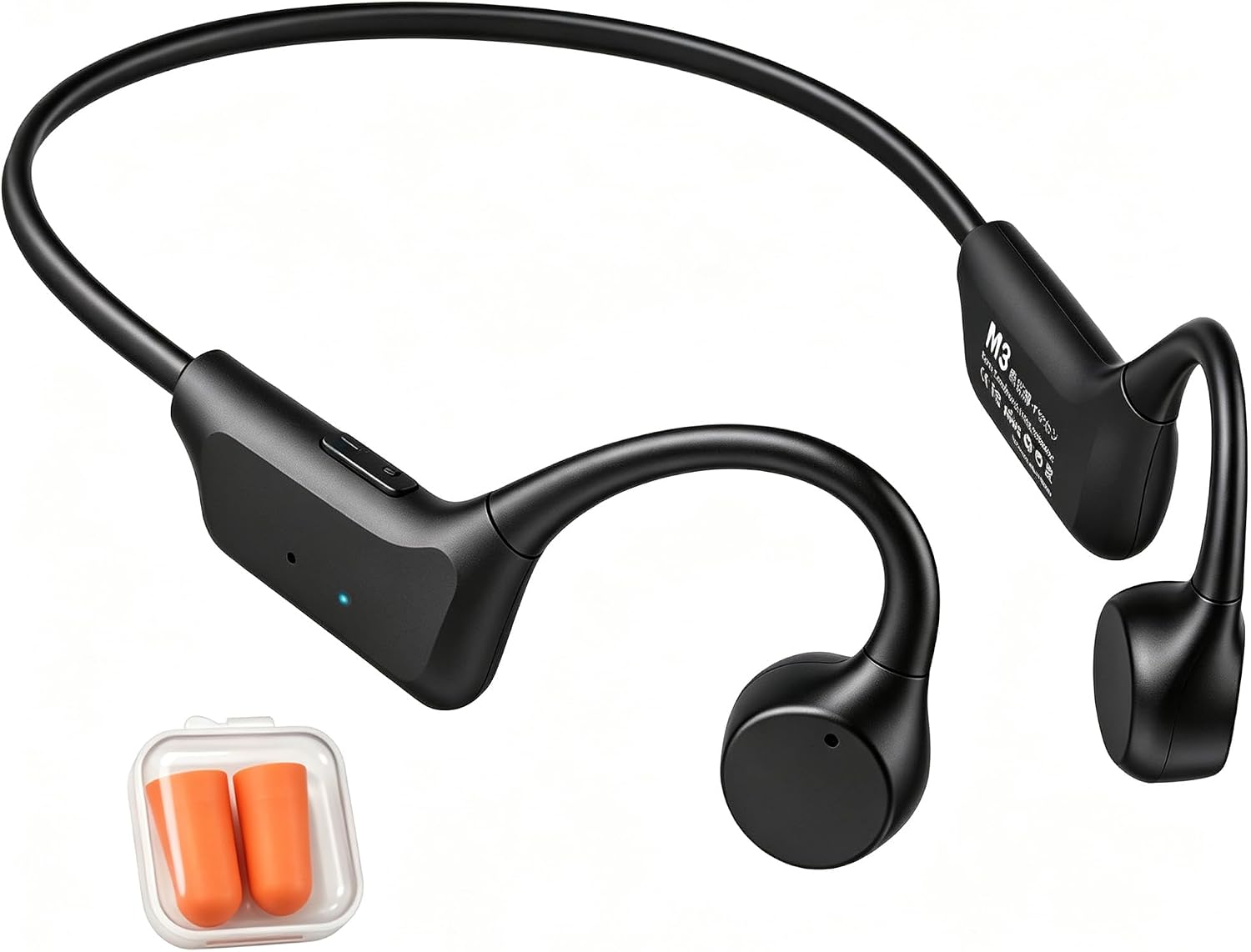
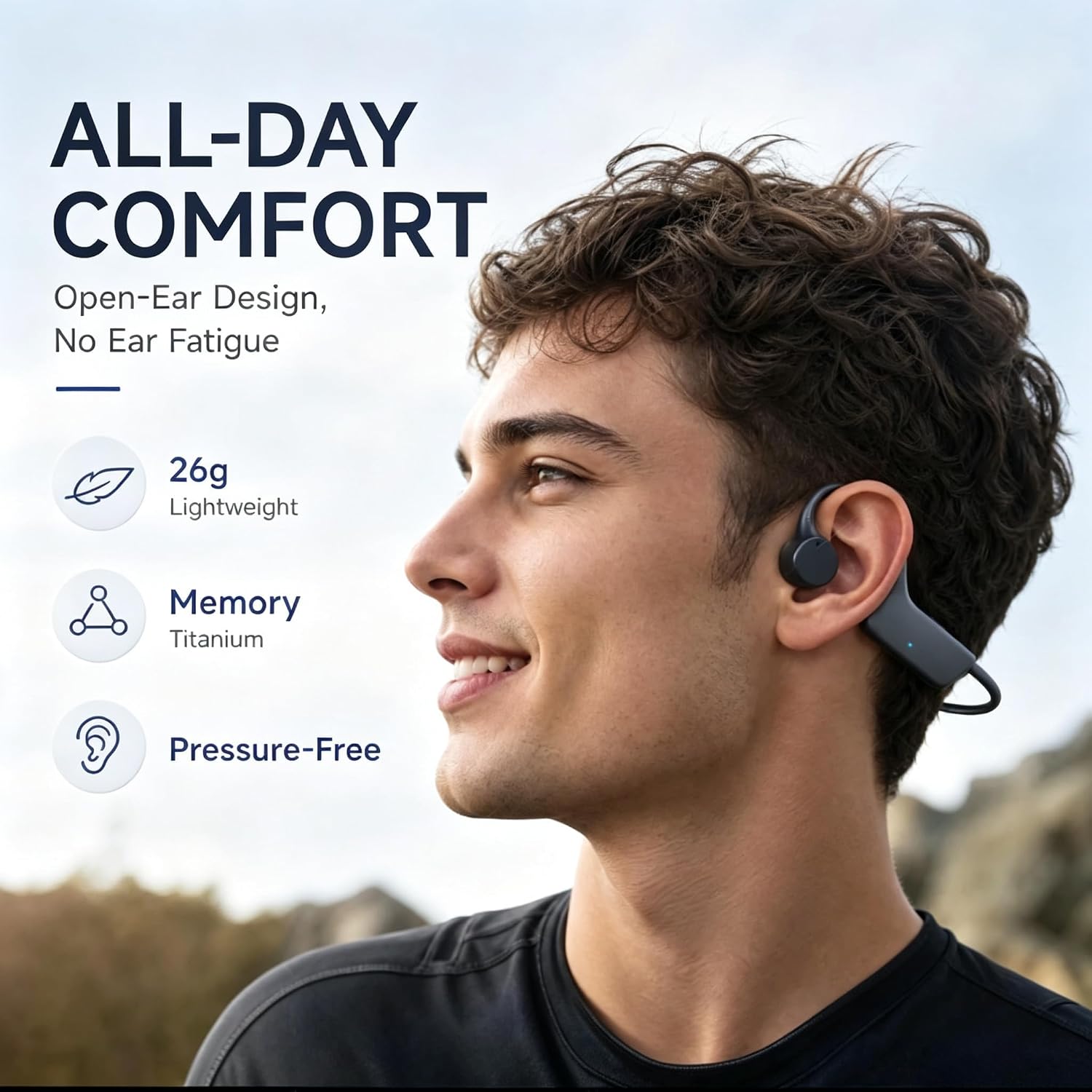
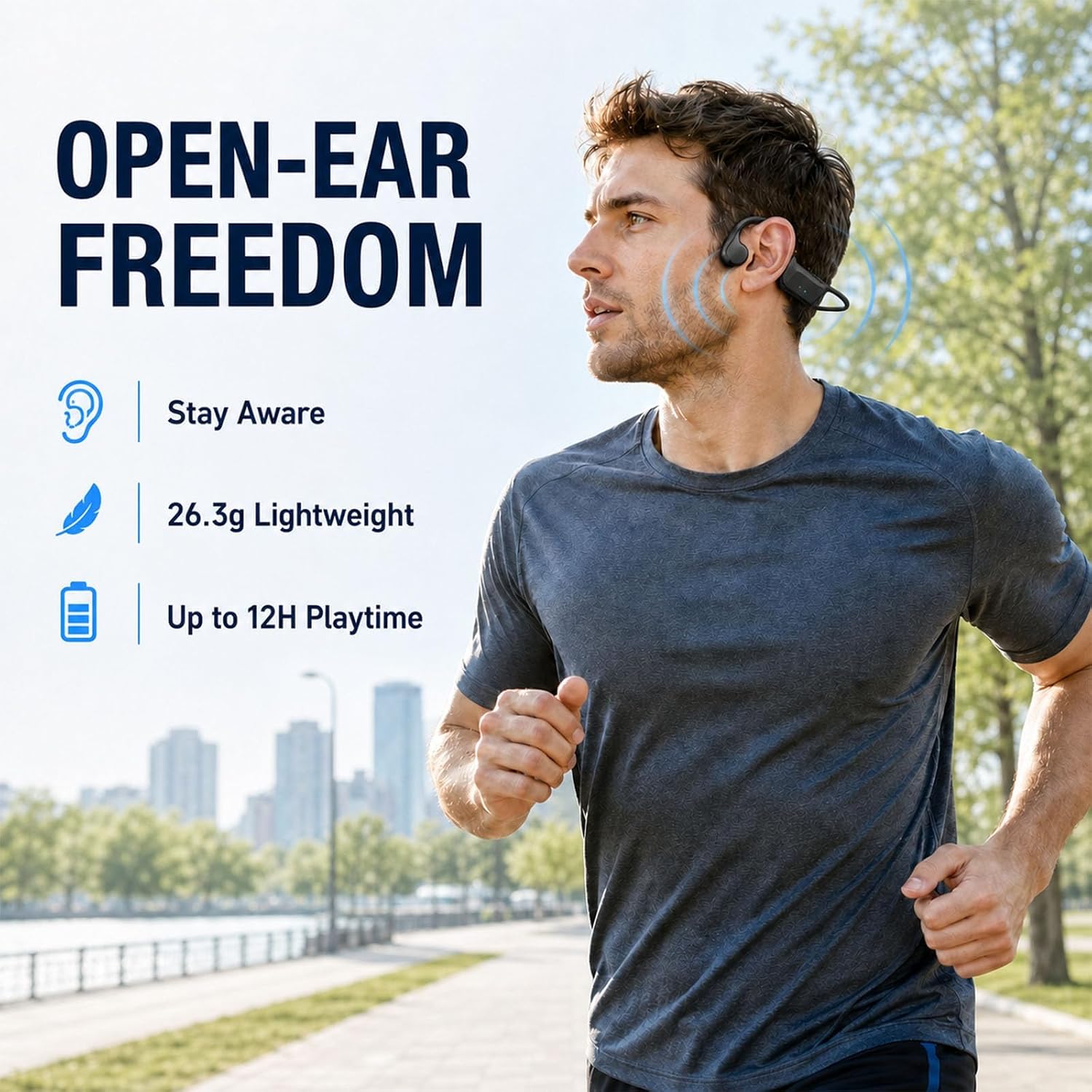
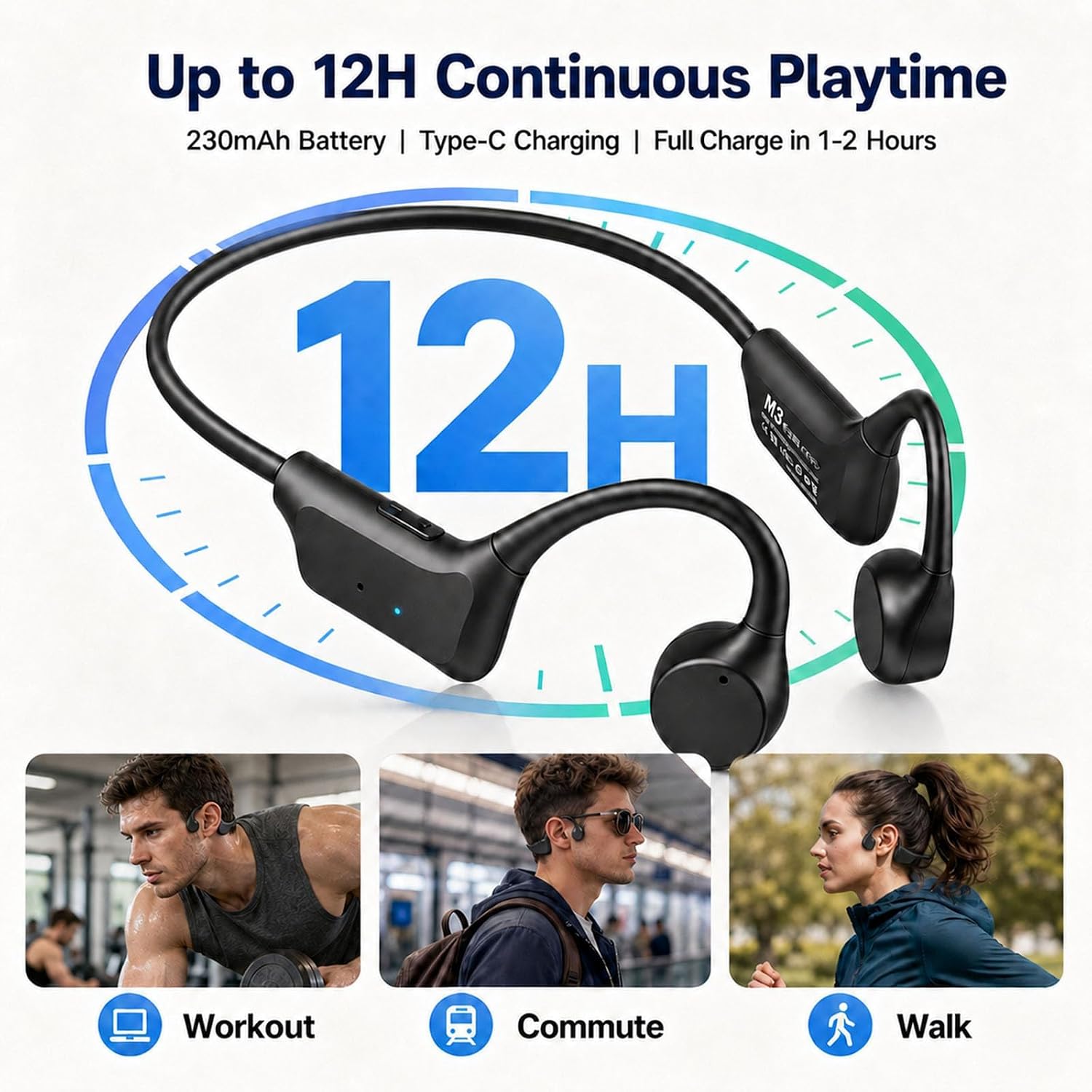
What the M3 gets right
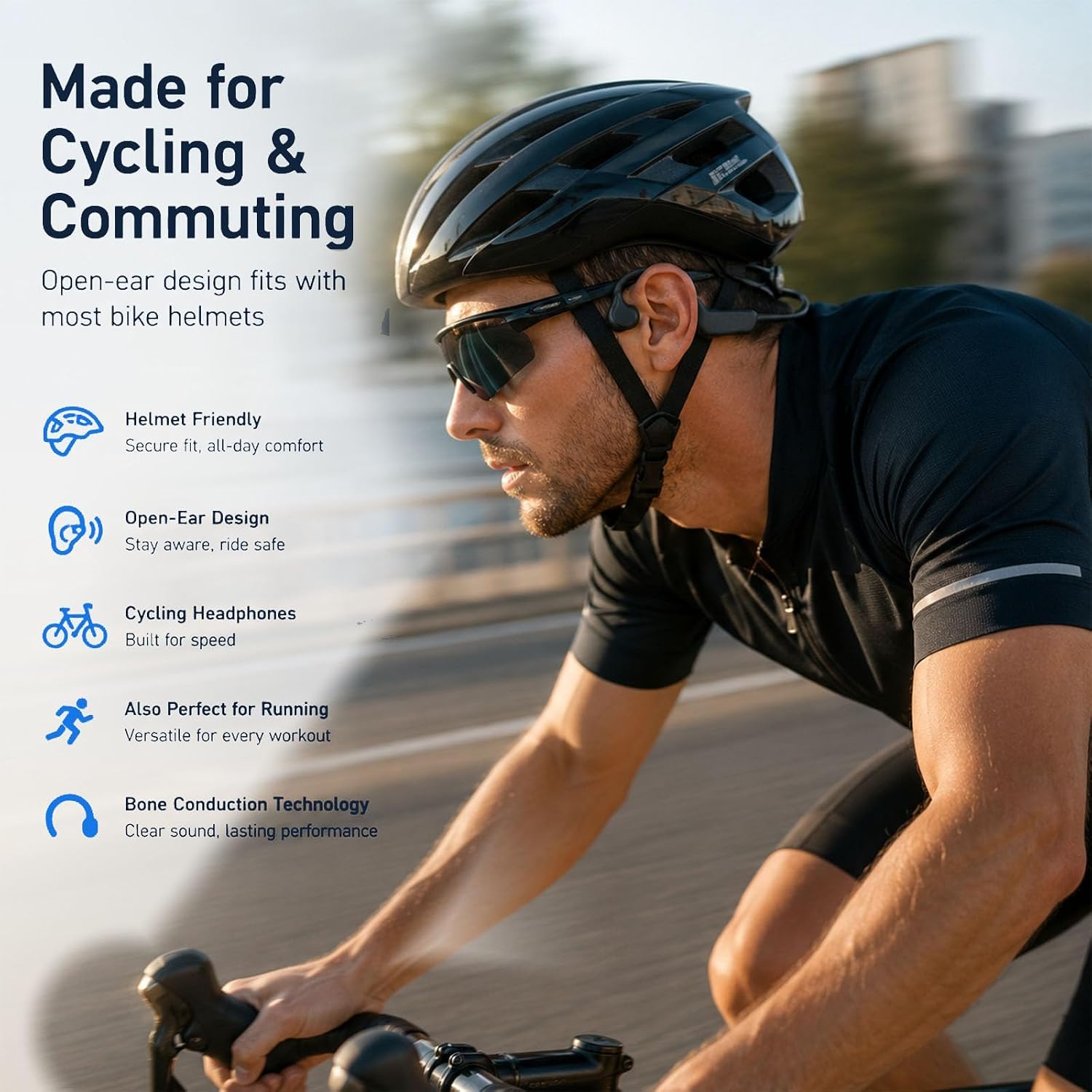
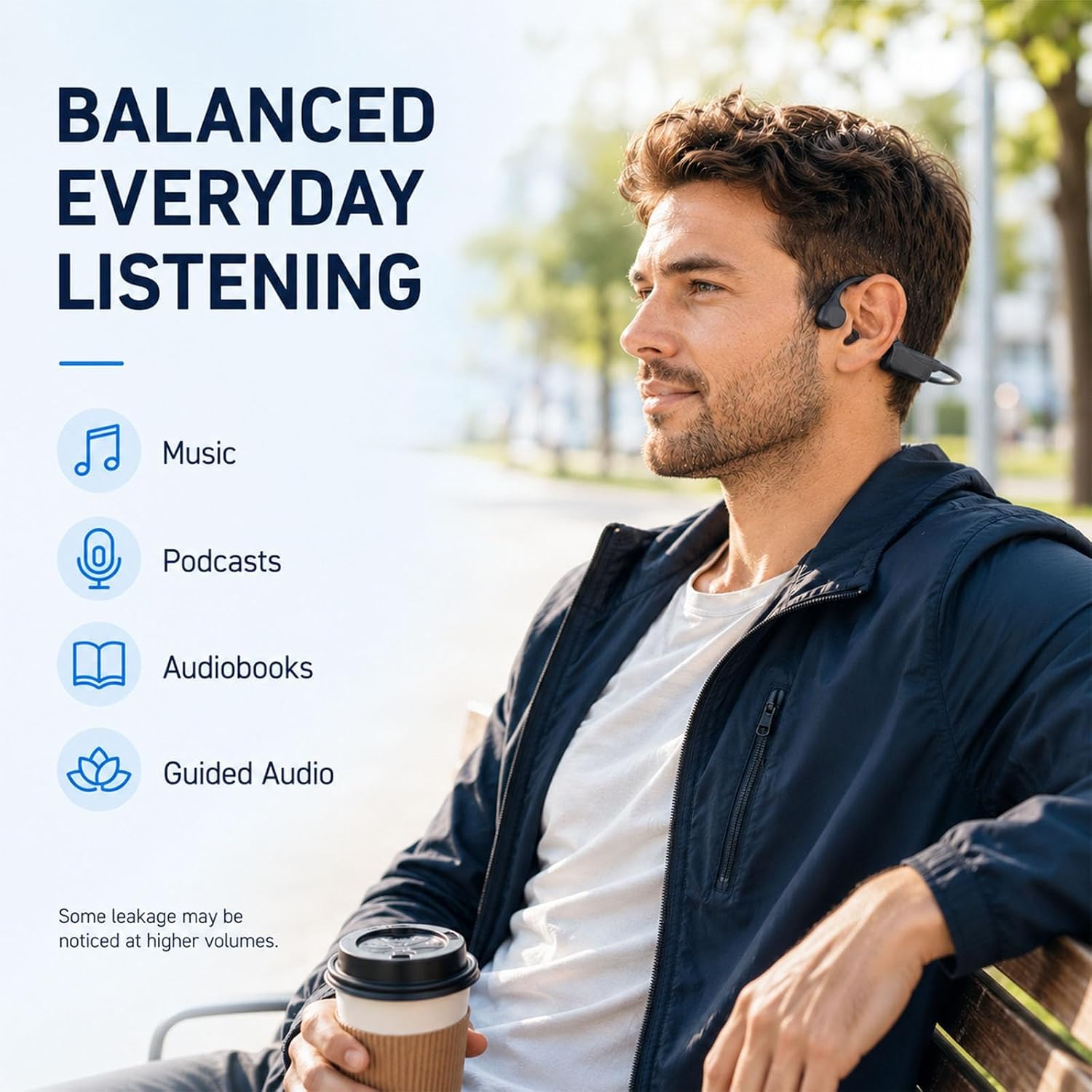
- Bone conduction keeps the ear canal open, so you hear traffic, voices and your surroundings while you listen.
- Up to 12 hours of playback on a single charge for commutes, workouts and everyday listening.
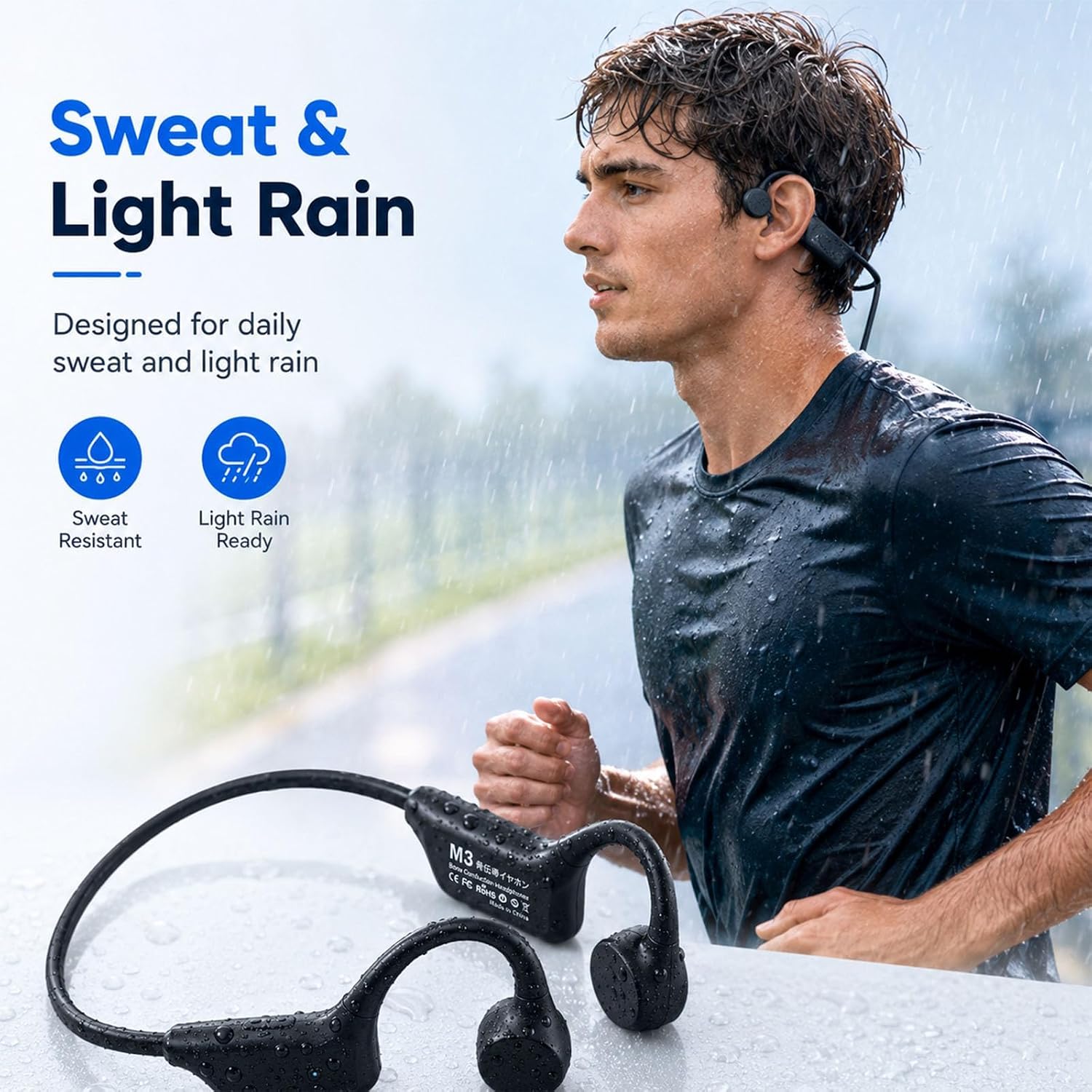
- IPX5 water resistance covers sweat and light rain during running, cycling, walking and gym sessions.
- Type-C charging gets it back to full with the same cable you already carry.
- Bluetooth 5.4 for a stable pairing with phones, tablets and laptops.
What is in the box
- Bone conduction headphones
- Earplugs
- USB charging cable
- User manual
KORAVIS M3 in numbers
Every figure below comes from the model's Amazon listing. Colourways share every value except the finish.
| Model | EL-OH-M3-01 |
|---|---|
| Type | Open-ear bone conduction |
| Playtime | Up to 12H |
| Charging | USB Type-C |
| Bluetooth | 5.4 |
| Water resistance | IPX5 |
| Impedance | 8 ohm |
| Colour | Black |
| Intended use | Adult, sport and everyday |
Who the M3 is for — and who should buy something else
The M3 is for listeners who want bone conduction, long runtime and a single Type-C cable, and who do not need the extra water margin of the M2. Because the driver vibrates through the cheekbone, the ear canal stays open, so cyclists, runners, walkers and gym users keep their surroundings audible while they listen. Up to 12 hours covers a commute, a workout and an evening without a charge, and the supplied earplugs help in noisy places.
Buy a different model in three cases. If water margin matters, the M2 carries IPX6 against the IPX5 M3, so it is the better pick for riders who train in the rain. If a published weight matters, note that KORAVIS publishes no weight for the M3 — the 25.5 g M2 and the 18.2 g Q1 are the only figures in the range. And if you want the lightest or the cheapest frame, that is the Q1, not the M3.
Two limits apply to everyone. The M3 is not swim-rated: IPX5 covers sweat and light rain, and the frame should never be submerged. And no model in this range competes with premium open-ear frames on call clarity or mid-range refinement.
- Choose the M3 for bone conduction with up to 12H and Type-C charging.
- Choose the M2 instead for IPX6 water margin and a published 25.5 g weight.
- Choose the Q1 instead for the lowest weight or the lowest price.
- The M3 is not swim-rated, and KORAVIS publishes no weight for it.
M3, M2 and Q1 compared — playtime, water, Bluetooth and driver type
Against its stablemates, the M3 matches the M2 on the two headline numbers and trails it on the water rating. Playtime is identical: both run up to 12 hours at standard volume, double the 8 hours of the Q1. Driver type is identical too — both are open-ear bone conduction, where the driver vibrates through the cheekbone rather than firing into the air.
Water is where they part. The M3 carries IPX5, the M2 carries IPX6, a higher level of jet resistance; the Q1 also sits at IPX5. None of the three includes a dust rating, and none covers immersion, so IPX7 and IPX8 swim protection is off the table across the range. Bluetooth is level: the M3 and M2 both run 5.4, the Q1 runs 5.3.
Weight is the gap you cannot close by comparing. KORAVIS publishes no weight for the M3; the M2 band is 25.5 g and the Q1 is 18.2 g. The M3 also charges over USB Type-C, as does the M2, so cable convenience is a draw rather than a differentiator. In short: pick the M3 for bone conduction and 12H at Type-C convenience, step up to the M2 for the stronger water rating, and step down to the Q1 only if weight or price wins.
What the M3 specifications actually mean in use
Twelve hours at standard volume is the figure that changes daily life: a commute, a workout, an afternoon of calls and an evening walk all fit before the frame needs a cable, provided you keep the volume moderate and the call time reasonable. Bluetooth 5.4 holds that link at up to 10 m / 33 ft, so a phone can sit in a bag or on a bench while you move.
IPX5 is water jets at level 5, with no dust rating attached — the everyday reading is sweat, light rain and a quick rinse, and nothing more. It sits one level below the IPX6 M2, and well below IPX7 or IPX8, which are the immersion ratings. That distinction decides where the M3 can go: a rainy run is fine, a pool or a shower is not.
Bone conduction is the feature you feel rather than read. The driver presses against the cheekbone and sends vibration straight to the inner ear, so the canal stays clear, audio keeps working when the canal is plugged, and the supplied earplugs become an advantage rather than a mute button — they block the room while the driver talks past them. Weight is not published for the M3, so judge the fit by wearing it rather than by a number.
The M3 by scenario: running, riding, gym, commuting and calls
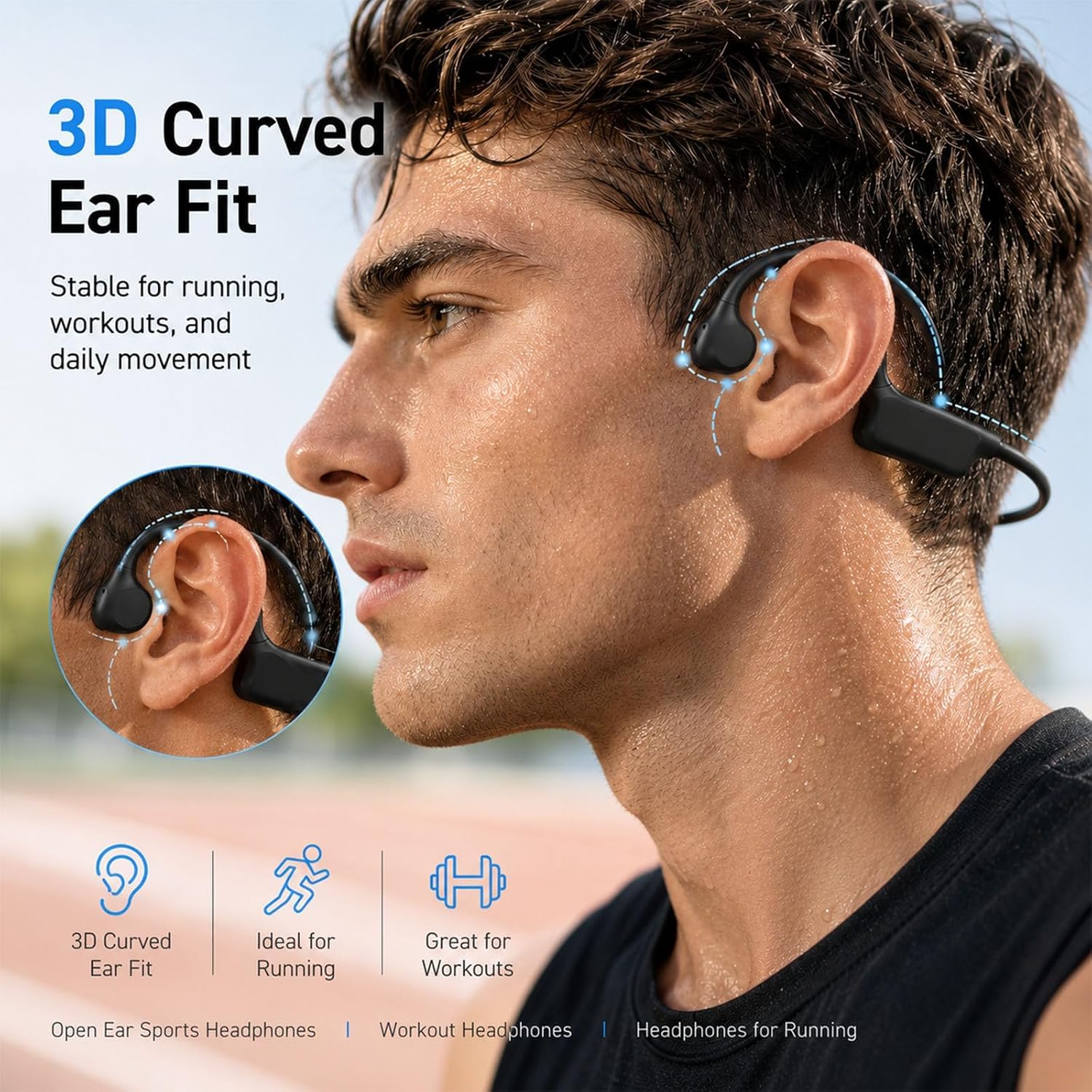
Training is the home ground of the M3. Running with an open canal means you hear cars, dogs and other people, and IPX5 absorbs the sweat of a normal session. The frame hooks behind the ear rather than sitting inside it, so it generally coexists with a cap, a helmet or glasses, and 12 hours of runtime survives even a long training week between charges.
Cycling rewards the same open-ear design, since traffic awareness is the point. Light rain is covered by IPX5; sustained downpours are where the IPX6 M2 gives more margin, so if you ride through real weather, that is the model to weigh. Gym training sits comfortably inside the rating, and the frame is not swim-rated, so it does not belong in a pool or a steam room.
Commuting and calls are straightforward. Type-C charging means one cable covers the frame and most of your other devices, Bluetooth 5.4 holds a steady connection at up to 10 m / 33 ft, and the earplugs let you raise the perceived volume on a noisy train or plane without turning the driver up. Call clarity is adequate rather than exceptional, and long call days will eat into the 12-hour figure.
Care, charging and making the M3 last
USB Type-C makes charging simple, and the 12-hour runtime means fewer cycles per week — itself a longevity advantage, because lithium cells lose capacity with every full charge. Charging overnight occasionally is harmless; leaving the frame permanently on a charger for months is not, and neither is storing it fully drained.
The charging port is where sweat does its damage. IPX5 stops the water in perspiration from hurting the frame, but the salt it carries stays on the metal contacts, corroding them and making the connection intermittent. Wipe the M3 dry after training, leave the port to air out, and never plug in a wet connector — that single habit does more for the lifespan of the frame than any accessory.
The driver and the frame are the sturdy half of a bone-conduction headphone; the cell is the wear item. Over time the sound and the fit should hold steady while the hours per charge slowly fall, and that is normal. Because KORAVIS publishes no weight for the M3, there is no figure to watch for drift — the practical check is simply whether the frame still hooks comfortably and whether a full charge still gets you through your day.
KORAVIS M3 — frequently asked
Should I use the earplugs?
They are included for noisy environments. With earplugs in, the bone conduction driver is easier to hear over background noise — useful on a plane or a busy train.
Can I swim with the M3?
No. IPX5 covers sweat and light rain. The M3 is not designed for swimming or for being submerged.
How do I pair it the first time?
Turn the headphones on and put them in pairing mode, then select KORAVIS from the Bluetooth list on your phone, tablet or laptop. Further connections are automatic while both are on.
How is the M3 different from the M2?
Both use an open-ear bone conduction frame with up to 12H of playtime. The M2 adds IPX6 water resistance, a 25.5 g nickel-titanium band and a 15.5 mm driver; the M3 is the newer, lighter-weight-everyday option with IPX5 and Type-C charging.
Compare with the other models
Same open-ear idea, different trade-offs on weight, battery and water resistance.
| Specification | KORAVIS M2 | KORAVIS Q1 | KORAVIS M3 |
|---|---|---|---|
| Type | Open-ear bone conduction | Open-ear air conduction | Open-ear bone conduction |
| Weight | 25.5 g | 18.2 g | Not published |
| Playtime | Up to 12H at standard volume | Up to 8H | Up to 12H |
| Bluetooth | 5.4, up to 33 ft / 10 m | 5.3, up to 33 ft / 10 m | 5.4 |
| Water resistance | IPX6 | IPX5 | IPX5 |
| Charging | USB-C, approx. 2 hours | USB, approx. 3 hours | USB Type-C |
| In the box | Bone conduction headphones, Earplugs, USB charging cable, User manual | Air conduction headphones, USB charging cable, User manual | Bone conduction headphones, Earplugs, USB charging cable, User manual |
See every model and colourway side by side
- M2 Open-Ear Bone Conduction Headphones — Our longest-running frame: 12H playtime, IPX6, and a 25.5 g nickel-titanium band.
- Q1 Open Ear Air Conduction Running Headphones — The lightest frame we make: 18.2 g, air-conduction drivers, and an 8H battery.
Buy the KORAVIS M3 on Amazon
The listing carries the live price, current availability and customer reviews, and your order is covered by Amazon's delivery and returns.